Who This Checklist Is For (and Why You Need It)
If you're the one tasked with sourcing industrial rubber or silicone products—gaskets, sealants, foam strips, maybe some RTV for a prototype—you know the drill. You get a request from engineering, operations, or even a client, and suddenly you're comparing nitrile vs. rubber gloves while trying to figure out what a '2mm rubber strip' actually specifies. I've been doing this for a few years now, managing roughly $200k annually in materials across 6 different vendors. This checklist is what I wish I'd had on day one. It's 6 steps, and it'll save you from the dumb mistakes I made. It's not a theoretical guide; it's a 'do this, then this, then this' manual.
Step 1: Decode the Request (The 5-Question Challenge)
Before you even touch a supplier website, you need to know exactly what you're looking for. Most internal requests are... well, vague. Someone says, 'We need a silicone sealant for a high-temp application.' That's not a spec, it's a conversation starter. You need to push back. Here are the five questions I ask every time, without fail:
1. What is the exact application? (Is it bonding, sealing, potting, gasketing? This decides if you need an RTV, a silicone foam, or an elastomer.)
2. What is the operating temperature range? (General-purpose silicone is -40°F to 400°F. If it's near an engine, you need a high-temp variant. If it's cryogenic, you need something else entirely.)
3. What is the substrate? (What is it sticking to? Glass, metal, plastic, concrete? Some silicones won't bond to polypropylene.)
4. Are there specific industry standards? (UL 94 for flammability, FDA for food contact, NSF for potable water. A client once rejected the order because the sealant wasn't WRAS-approved. That was a $2,400 lesson.)
5. What is the required hardness or durometer? (For a rubber strip or gasket, this is a number from the Shore A scale. Do they need it soft like a foam, or hard like a solid rubber?)
I created a one-page form for this. It's a simple checklist, and the engineers initially hated it. But it cut my initial 'specifying' time by 80% and eliminated the back-and-forth emails. The five minutes spent on those questions saves days of correcting the wrong part.
Step 2: Match Material to Application (Don't Assume 'Silicone' is the Answer)
This is the biggest mental shift I had to make. Everything you read tells you silicone is the premium, all-purpose material. And it is, for a lot of things. But 'my experience with about 150 different material sourcing projects suggests otherwise' in many cases. I've seen people spec a GE Momentive silicone RTV when a much cheaper polyurethane or epoxy would have performed better and lasted longer. Here's a basic rule of thumb I use:
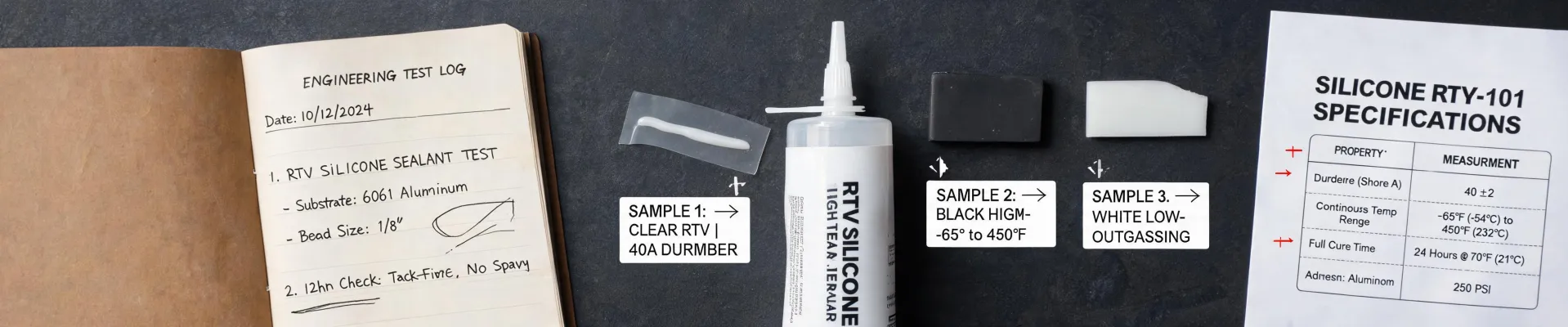
- For high-temperature stability, flexibility, and electrical insulation: Silicone (like Momentive's LS series or their RTV rubbers) is usually the winner. It stays flexible in the cold and doesn't crack in the hot.
- For potting electronics: You need a silicone gel or an encapsulant. That's a different beast than a construction sealant.
- For a simple weather seal: A solid silicone rubber or a silicone foam strip (like a closed-cell sponge) is perfect. But for a high-abrasion seal, a more durable urethane might be a better choice.
- For a '2mm rubber strip': That's a trap! 'Rubber' could be anything. NBR (nitrile) for oil resistance. EPDM for weather resistance. Silicone for temp extremes. I still kick myself for assuming 'rubber strip' meant EPDM. The client wanted a silicone strip for a food processing line. I ordered the wrong thing and delayed a project by a week. Don't assume.
Step 3: Source from the Right Vendor (The Momentive Angle)
Once you know the material, you need to find a supplier. If you need a proven, industrial-grade silicone and the application is critical, looking at brands like Momentive is a smart first step. Their product line for high-performance silicones (the ones that come from the old GE Silicones heritage) is comprehensive. The key is not to just buy a random 'silicone'. You look for specific products on the Momentive engineering site. For instance, if you need a low-modulus sealant with high movement capability for a building joint, that's a specific product family. If you need a potting gel for a power supply, that's another. Don't just call and say, 'I need silicone.' Call and say, 'I need a two-part RTV silicone with a durometer of 30 Shore A and a thermal conductivity of >2 W/mK.' That gets you a solution immediately. (Honestly, I'm not sure why some buyers refuse to do this homework. It makes them look like a pro.)
Step 4: Verify the Specs with Data Sheets (This is Not Optional)
This is the step everyone tries to skip. 'Yeah, it's the right stuff.' No. You verify. You pull the Technical Data Sheet (TDS) and the Safety Data Sheet (SDS). You look for these specific numbers:
- Color matching: If the client needs it to match a specific color (like a corporate blue), you need to know the color tolerance. A standard color tolerance in the industry is Delta E < 2 for brand-critical applications. Most people won't see a difference, but a trained eye will. If your supplier can't guarantee a color tolerance in writing, find one who can.
- Viscosity: If you need a flowable sealant vs. a thixotropic paste, this is critical.
- Cure time: Is it a 1-part moisture cure that takes 7 days, or a 2-part addition cure that can be done in 2 hours? The difference can break a production schedule.
- Hardness (Durometer): As mentioned, the Shore A number. A 2mm rubber strip that is 60 Shore A feels and performs very differently from one that is 80 Shore A.
The last time I ignored a TDS, I bought a silicone foam that was meant for acoustic damping, not thermal insulation. It was a $400 mistake that I ate because the project was too late to re-order. Now? 5 minutes to read the TDS.
Step 5: Ask the Critical 'CoA' Question
This is the insider tip that most people miss. Before you approve a purchase order for a large or critical batch, ask for a Certificate of Analysis (CoA). This is a document from the manufacturer that shows the specific test results for the batch you are buying. It is not the same as a generic TDS. The CoA will confirm the actual viscosity, durometer, specific gravity, and cure time for that specific lot. I now make this a standard part of my purchase order. It protects me if something goes wrong, and frankly, it forces the supplier to ship their A-grade product. If a supplier (like a distributor for Momentive) hesitates or charges extra for a CoA, that is a red flag. Find another distributor. The $25 they might charge for the CoA is cheaper than re-ordering 200 units of a bad batch.
Step 6: Plan for the 'What If' (Returns, Storage, and Shelf Life)
You got the 2mm silicone strip. It's perfect. But what happens if it's the wrong one? Before you pay the invoice, clarify the return policy. Most silicone products have a shelf life (12 months is common for one-part RTV silicones). If you buy a 10-case lot and it sits in the warehouse for 11 months, you've just bought expensive garbage. Also, check the storage requirements. Some silicone foams and elastomers need to be stored in cool, dry conditions. I've had a shipment of silicone gel degrade because our warehouse hit 110°F in the summer. The vendor didn't warn us, and I didn't ask. (One of my biggest regrets: not asking about storage limits. We lost $800 worth of material.)
Don't Skip This: The Most Common Errors
My list of errors is a mile long, but these are the three I see most often from new buyers and even some experienced ones:
1. Forgetting the secondary materials. You buy the silicone sealant, but forget the primer or the specific cleaner that the TDS requires for a good bond. The sealant fails, and you blame the product. I wasted a week figuring this out once.
2. Not confirming the unit of measure. '5' could be 5 kg, 5 gallons, or 5 cartridges. Always clarify. I had a supplier ship 5 gallons when we needed 5 cartridges. It was a waste of money.
3. Ignoring the 'small print' on shipping. Adhesives and sealants are often classified as hazardous goods (DG). Shipping cost on DGs can be 2-3x higher. If a freight quote seems too good to be true, it's because they didn't factor in the hazmat fee. Always ask: 'Is this DGs? What is the total freight including fees?'