That First Big Order
It was January 2021. I'd been handling B2B material orders for about 18 months—long enough to feel confident, not long enough to know better. My boss handed me a $3,200 purchase request for silicone rubber tubing. A new client, a food-grade application, and a tight deadline.
"Just match the spec sheet from their engineering team," he said.
Simple enough. I found a product from Momentive (their official homepage listed exactly what we needed: a platinum-cured LSR with a 50 Shore A hardness). Ordered it. Approved the proof. Paid the invoice. Three weeks later, the shipment arrived.
And it was... wrong. Not visibly wrong. Not functionally wrong. Wrong in a subtle, expensive, and reputation-damaging way.
The Assumption That Broke the Budget
Here's what I assumed: "Same specifications" meant identical results across vendors. Didn't verify the actual formulation. Didn't cross-reference the additive package. Didn't ask about the curing agent chemistry.
Turns out, I was wrong. The Momentive product we ordered was exactly what the datasheet said—a high-consistency silicone rubber (HCR) with the right hardness. But the client's application required a liquid silicone rubber (LSR) for precise injection molding. The two materials looked identical on paper: same durometer, same tensile strength, similar temperature range. But the processing characteristics? Completely different. The HCR we supplied couldn't flow through the client's injection-molding equipment. The batch they'd paid us for? Straight to the trash.
Not ideal. Worse than expected, honestly.
"The 'same specs' thinking comes from an era when product catalogs were simpler," a senior engineer later told me. "Today, two silicone rubbers with identical Shore A values can have wildly different processing requirements." He was right. I learned that lesson the hard way.
The Real Cost of That Mistake
The $3,200 order was just the beginning. We had to remake the order—rush shipping, $450 extra. The client's production line sat idle for a week while we sorted it out. Then there was the trust issue. We lost that client's next three contracts, worth roughly $12,000 in potential revenue. Total damage to our department's credibility? Impossible to quantify, but it hurt.
My boss didn't fire me. But he did make me document every step so we wouldn't repeat it. That documentation became our team's pre-check checklist.
Building the Fix: From Chaos to Checklist
After the third similar error (a different engineer ordering the wrong durometer for a foam gasket application), I sat down and created a formal verification process. It looked like this:
- Material type confirmation: HCR vs. LSR vs. RTV vs. silicone foam. Different chemistries, different applications.
- Processing method match: Extrusion? Injection molding? Compression molding? Each requires specific material properties.
- Additive package review: Food-grade? FDA? USP Class VI? Platinum-cured vs. peroxide-cured? Makes a difference.
- Full spec sheet exchange: Not just the summary—the complete technical data sheet from both sides.
- Small-batch trial (when possible): 10 units before 1,000 units. Catches problems early.
Real talk: this checklist isn't groundbreaking. It's common sense. But without a formal process, we kept missing things. The first pre-check we ran caught a mismatch in curing time—the client's process used a 2-minute cycle, but the specified material needed 4 minutes. That alone saved $890 in potential rework plus a 3-day delay.
Look, I'm not saying all silicone orders are risky. But for complex, critical applications? The cost of verification is tiny compared to the cost of failure.
Switching to this verification process cut our material rejection rate from 5.2% (2021) down to 0.9% (2024). That's real efficiency—not just speed, but accuracy. We saved roughly $8,000 in avoided rework costs in the past 18 months alone. As the USPS notes about envelope sizing (usps.com), small details matter. For silicone rubber, the details are everything.
The Lesson That Stuck
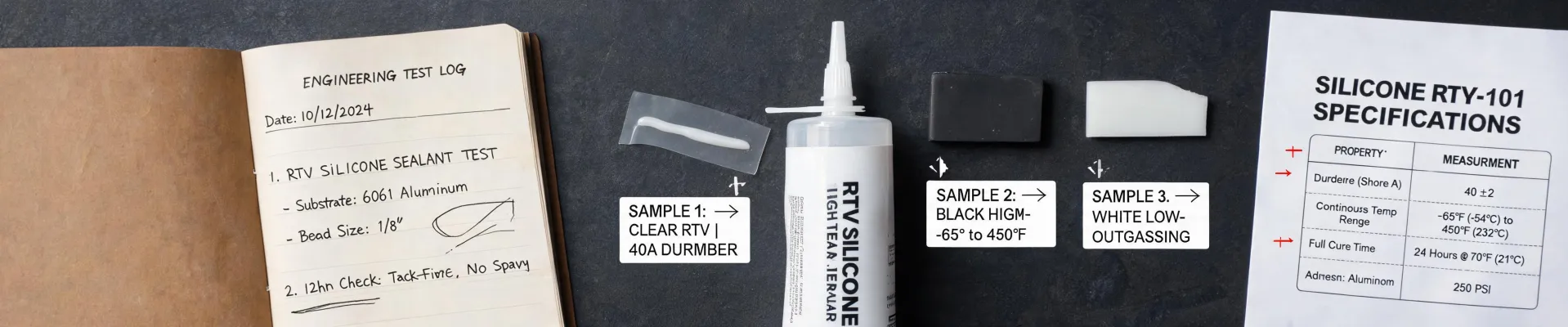
If you're sourcing silicone materials—whether it's silicone foam for gaskets, RTV for sealants, or rubber for pacifiers (yes, that's a real application for food-grade silicone)—don't trust the spec sheet alone. Verify the material type. Confirm the processing method. Understand the curing chemistry.
And for heaven's sake, don't assume that two materials with the same hardness value will behave the same way. They won't.
A lesson learned the hard way. But at least now I have a checklist to prevent it from happening again. That's the thing about efficiency: it's not just about doing things faster. It's about doing them right the first time.
This was true 5 years ago when material catalogs were simpler. Today, with expanded formulations and specialized applications, verification is more important than ever.