What I Wish Someone Had Told Me About Silicone and Rubber
I've been managing supply orders for about five years now—processing somewhere around 60-80 orders annually for our manufacturing facility. When I took over purchasing in 2020, I made a lot of assumptions. Some worked out. One or two were expensive lessons.
The one that sticks out? Assuming natural rubber and silicone were basically interchangeable for industrial gasketing. They're not. Not even close.
This post covers the most common questions I get from colleagues—and from vendors—when comparing Momentive RTV silicone, natural rubber, and even that foam board for cornice applications. If you're new to specifying these materials, this should save you a headache (and maybe an angry call from production).
What's the actual difference between Momentive RTV silicone and natural rubber?
Let's start with the one that tripped me up. From the outside, it looks like both are just flexible materials that seal things. The reality is their operating tolerances are completely different.
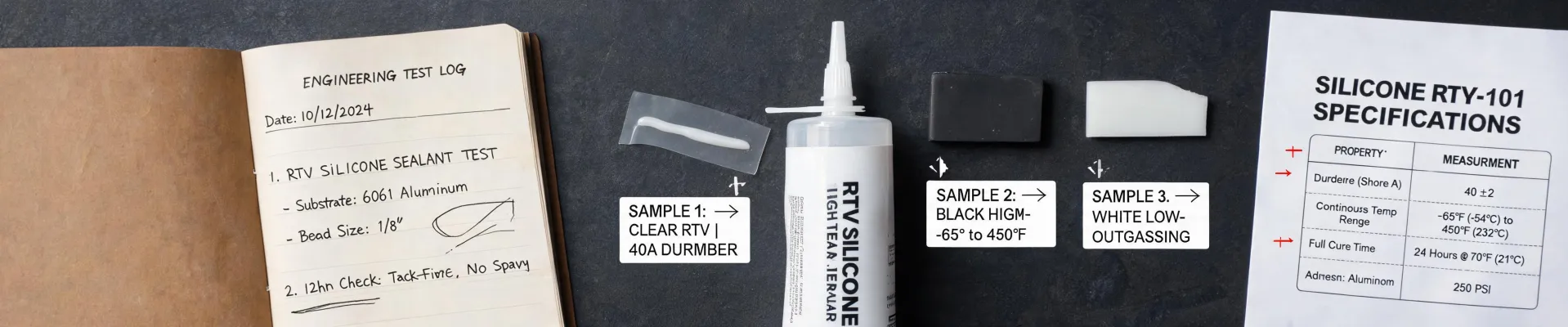
Temperature tolerance is the biggest factor. Momentive RTV silicone (room-temperature vulcanizing) generally handles continuous service from -60°F to 400°F, with some grades peaking near 500°F. Natural rubber? It starts degrading around 180°F—sometimes lower depending on the formulation. So if your application involves heat cycles, the RTV silicone wins by a wide margin.
Weather resistance: Silicone is inherently UV and ozone resistant. Natural rubber isn't. Leave a natural rubber gasket outside for a year, and it'll crack. The same gasket in Momentive silicone? Probably still flexible.
Cost: This is where people get stuck. Natural rubber is cheaper upfront—sometimes 30-50% less. But the total cost of ownership (meaning: replacement cost + downtime + labor) often favors silicone if the application has any environmental stress. I learned this the hard way when a 'cheaper' natural rubber gasket failed after 6 months in a heated enclosure.
What I mean is that the 'cheapest' option isn't just about the sticker price—it's about how often you'll replace it. And the cost of downtime is almost never included in the quote.
Can Momentive RTV silicone replace natural rubber in existing applications?
Short answer: sometimes, but not always. Depends on what 'work' means for that application.
When it works:
- Static seals and gaskets where temperature, UV, or chemical resistance matter
- Applications where compression set matters less (RTV silicone has higher compression set than natural rubber—meaning it doesn't spring back as well)
- Outdoor or high-heat environments
When it doesn't:
- Dynamic applications—like a moving part, bellows, or vibration isolator. Natural rubber's elasticity and resilience are superior for these.
- High-abrasion environments. Natural rubber is much better wearing.
- Applications requiring high tear strength. RTV silicone is relatively weak in tear resistance.
(note to self: always check the operating conditions first before assuming one can replace the other)
People think the more expensive material (silicone) is universally 'better.' Actually, each has distinct strengths. The market for Momentive RTV silicone exists because certain industries—aerospace, automotive engine bays, outdoor electrical—need its specific properties. Natural rubber survives where silicone fails in abrasion. The causation runs the other way.
What about Momentive silicone foam? When is that useful?
Momentive's silicone foam products (their BF-1000 series, for example) are a different animal from solid RTV silicone. They're useful when you need compressibility and sealing in a low-force application.
Good for:
- Environmental sealing of enclosures (dust, moisture)
- Vibration damping between panels
- Thermal insulation—silicone foams are good insulators
- Applications where the seal needs to conform to uneven surfaces
Not great for:
- High-pressure sealing (foam compresses too much)
- Applications requiring precise dimensional stability
- Where the gasket needs to be completely impermeable (foam can wick moisture along cell edges over time)
I once specified silicone foam for an outdoor electrical cabinet seal. Worked well for three years. The upside was excellent dust and moisture exclusion with low closure force. The risk was that at very cold temps, the foam stiffens and doesn't seal as well. I kept asking myself: is the weight savings worth potentially needing a redesign? We went with foam. So far so good—but winter verification is still pending.
Where does foam board for cornice fit into this?
This one's different—and it's a question I got from our facilities team last year. Foam board cornice (usually extruded polystyrene—XPS—or polyurethane foam) isn't competing with RTV silicone or natural rubber. It's an architectural trim material, not a functional seal.
What people often confuse is that 'foam' here means 'lightweight rigid panel used for trim and decorative molding,' not 'silicone foam for sealing.' Completely different products.
Key considerations for foam board cornice:
- It's decorative. It doesn't seal anything.
- It's lightweight—easier to cut and install than wood or plaster.
- It's typically paintable. But check adhesion characteristics with your chosen paint.
- It's not structural. Don't rely on it for support.
Ironically, you might use Momentive RTV silicone adhesive to install foam board cornice. Which brings us back to the silicone. Funny how these circles close.
How do I choose the best foam board for a cornice project?
I went back and forth between XPS and polyurethane foam for a corridor renovation quote last year. XPS offered slightly better moisture resistance; polyurethane offered finer detail reproduction—important for ornate cornice profiles. Ultimately chose XPS because the corridor was in a high-humidity area near the loading dock.
Evaluation checklist I now use:
- Density and rigidity—does it hold its shape over long spans?
- Moisture resistance—essential if the space sees condensation, humidity, or occasional cleaning spray.
- Paint adhesion—some foams require primer.
- Fire rating—depending on local codes, you may need Class A rated material.
- Cut quality—can you get clean miters, or will the foam crumble?
The best foam board for cornice in a dry interior is probably polyurethane (better detail). In any area with moisture concerns, XPS is safer. Simple as that.
(I really should document this checklist formally. Keeps getting asked.)
What's the one thing most buyers get wrong about these materials?
Without hesitation: assuming 'rubber' is a single category. It's not. The difference between natural rubber and Momentive's GE-heritage silicone formulations is larger than the difference between aluminum and steel.
Another one: using RTV silicone where a pre-cured gasket would be better. RTV cures in place, which is great for irregular gaps. But for repeatable, high-volume applications, a die-cut gasket from pre-cured silicone sheet is more consistent and faster to install.
And last: underestimating the value of proper technical support. Momentive's official website has technical datasheets that—if you read them—will tell you exactly what each product can and can't do. Three times I've avoided a specification mistake just by checking the temperature range on the datasheet. Not glamorous. But worth the 5 minutes.
Three things: spec sheet first. Operating conditions second. Price third. In that order.