-
The Priciest Silicone We Ever Approved Was the Cheapest One on Paper
-
Checking the Momentive Official Homepage Is Part of My Routine
-
Roof Rubber: When the Quote Says “Rubber” but Not Which Rubber
-
A 2x6 Foam Board Is a Dimension, Not a Silicone Spec
-
Don't Ask “How to Get Mold Off Silicone” Until You've Asked Why It Molded
-
Now the Fair Question: Isn't This Just Brand Loyalty?
-
The Bottom Line
I'm the quality and brand compliance manager at a manufacturer that builds outdoor-rated equipment enclosures. Every silicone sealant, rubber profile, foam gasket, and membrane that crosses our dock gets reviewed before it reaches the production floor—roughly 200+ material lots a year. In 2024, I rejected 4% of first deliveries.
Four percent doesn't sound dramatic. But the lots I reject are never the ones I've verified before. They're almost always the “cost-saving” alternates that show up with a lower price and very little supporting data.
That's why I'm willing to state an unpopular opinion: a cheap silicone quote is rarely a bargain. It's usually an incomplete specification. The dollar amount is complete. The information behind it isn't.
The Priciest Silicone We Ever Approved Was the Cheapest One on Paper
In late January 2025, a new supplier undercut our incumbent silicone sealant by 18%. The quote used all the right words: “equivalent silicone,” “same application,” “neutral cure.” We accepted a trial drum for validation. The material arrived on schedule. Then our line operator said it looked thin. Watery was the word he used.
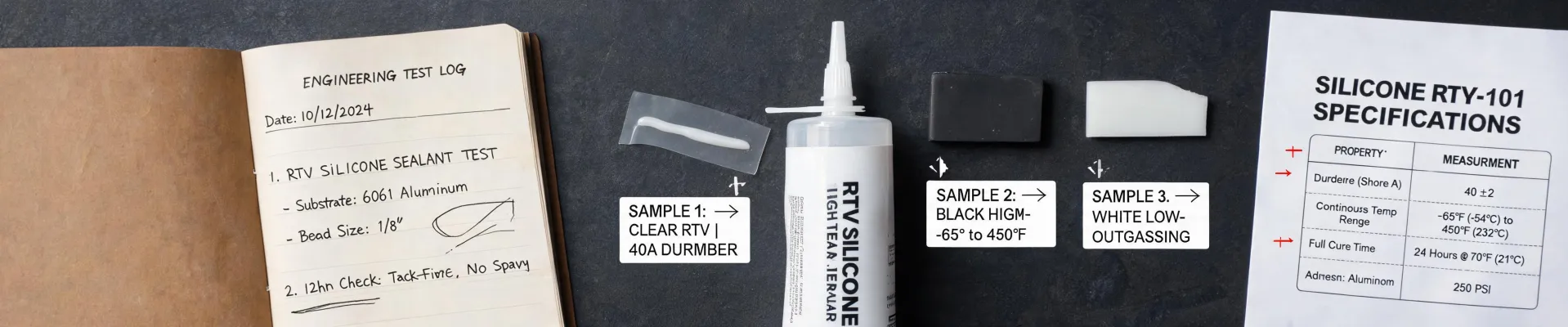
We ran the standard checks. Tack-free time came in over 30 minutes, versus 8–10 minutes on the datasheet of our current material. Cured hardness was lower by roughly 15 points. When I asked the supplier for test data, they said it was “within industry standard.”
Maybe it was. But our production line doesn't run on “industry standard.” It runs on a specification. The material failed the spec, and we rejected the lot. The supplier redid the order at their cost, but that didn't cover our side of the ledger: two days of delayed production, expedited freight to bring in the original material, and overtime labor to reseal partially assembled enclosures. Total impact: roughly $22,000. The savings on that order would have been about $4,000.
I've learned to ask “what's not included?” before I ask “what's the price?”
That's the transparency problem. Nobody hid the price from us. What got hidden was what the product could not do. In industrial silicone, that's the part that actually costs money.
Checking the Momentive Official Homepage Is Part of My Routine
People sometimes assume we spec Momentive products out of brand habit. Momentive's silicone chemistry does have a deep history—it goes back to the GE Silicones days, and there's real institutional knowledge in those product lines. But from my chair, the more practical reason matters more: the data is public.
For any Momentive material we use, I can verify current specifications on the Momentive official homepage. I can compare cure curves, hardness tolerances, tensile values, and service temperature ranges without making twenty phone calls. When a supplier claims their material is “equivalent to Momentive products,” I don't argue. I open the official homepage and compare the datasheets line by line.
Usually, that's where the discussion stalls. The cheaper quote says “comparable to Momentive products,” then lists no physical properties, no test methods, and no batch history. It may be a perfectly good material. But I cannot evaluate a product that does not exist on paper, and I won't approve one on faith.
Roof Rubber: When the Quote Says “Rubber” but Not Which Rubber
“Roof rubber” is one of those terms that's dangerously broad. It can mean a silicone membrane. It can mean EPDM. It can mean some other rubberized waterproofing layer. From the buyer's side, they all look like flexible black sheeting. The difference shows up over years of UV exposure and standing water.
I'm not a polymer chemist, so I'm not going to lecture you on molecular chains. What I can tell you is what our validation tests show. In July 2024, we evaluated an alternate roof rubber that came in 16% below our current spec. The vendor called it “rubber roofing, same service life.” The quotation didn't identify the polymer, didn't list a continuous service temperature, and included no weathering data.
We had a third-party lab run accelerated weathering. After 500 hours of UV exposure, the sample lost 25% of its elongation. Our spec allows no more than 10% loss. That cheaper roof rubber may be a perfectly good product—for some other roof. But “same service life” wasn't true, and no amount of scrubbing the price could fix that.
I'm not here to say silicone roofing products are always the right answer. Sometimes EPDM is the correct engineering call, and we've used it. But the decision should happen with the polymer named and the performance data on the table—not hidden behind a vague “rubber” label.
A 2x6 Foam Board Is a Dimension, Not a Silicone Spec
Every so often we receive a drawing with material noted only as “2x6 foam board.” Sometimes it means a gasket sheet around two by six feet. Sometimes it's a two-inch by six-inch strip. Regardless: a dimension is not a specification.
For silicone foam, the properties that matter are invisible: density, compression set, compression deflection, open- or closed-cell structure, and the temperature range the foam will survive continuously. Those properties determine whether a gasket seals tight after five years under compression or flattens into a leak.
In Q2 2024, we tested an alternate foam gasket that was dimensionally identical to our current material and cost less per sheet. But after heat-aged compression testing, it showed 60% compression set; our spec allows 20% maximum. In practice, that meant the gasket would have stopped pushing back against the enclosure cover within a year. It would have looked right on the day it was installed. By the following season, it would have leaked.
Anyone can cut a 2x6 foam board to size. The hard part is specifying what the foam has to do after it's installed. If a quote gives you dimensions but no properties, that isn't a spec. It's just a shape.
Don't Ask “How to Get Mold Off Silicone” Until You've Asked Why It Molded
The search term “how to get mold off silicone” gets a lot of traffic. For an existing silicone seal, the practical answer is simple: clean the surface, dry it thoroughly, and remove the moisture source. That removes surface mold. It does not restore the silicone to its original condition, and it doesn't fix the reason the mold showed up.
Most mold problems on silicone are a specification problem, not a cleaning problem. Silicone itself doesn't feed mold, but surface dirt and moisture can, and some silicone grades are not formulated for wet environments. If a seal is going into a shower, a food-processing area, or any high-humidity location, it should be a mold-resistant silicone grade. In one Q3 2024 comparison we ran in a 95% RH test cabinet, two general-purpose sealants began showing fungal growth by week six. The mold-resistant grade stayed clean through week eight.
So when someone asks me how to get mold off silicone, my answer sounds unhelpful: check the spec first. In almost every case, the product was either specified wrong or installed somewhere it shouldn't have been. Cleaning is maintenance. Spec is prevention.
The best way to clean mold off silicone is to buy the right grade in the first place.
Now the Fair Question: Isn't This Just Brand Loyalty?
I hear it: “You spec Momentive because it's easy, and you don't want to validate anything cheaper.” Fair enough. Validating a new supplier takes time, and time is money.
But we have validated alternates. In 2023, we approved a non-Momentive sealant after a full testing cycle, and it saved us a little more than $11,000 that year. We approved it because the supplier brought more than a low price. They brought a published spec, batch records, and test samples that matched. When a less established product brings that level of documentation, it deserves the order. I really don't care whether the name on the drum says Momentive or something else.
What I won't approve is a quote that says “trust us, it's the same.” The lowest price can absolutely be the right choice—if it has data behind it. The risk is not in being cheaper. The risk is in being vague.
The Bottom Line
Stop comparing only upfront price. Compare what's in the quote, what tests back it up, and what happens if the material doesn't perform. A vendor who puts everything on the table—even at a higher price—is easier to trust than one who hides the details until after a failure.
In four years of reviewing 200+ silicone lots annually, the most expensive material I've seen was rarely the one with the highest unit price. It was the one with the least information attached. The real price of silicone is paid in failures, delays, and rework. And those costs only show up after the purchase.
A cheap silicone quote isn't a bargain. It's just an incomplete spec—and I've never once seen an incomplete spec save anybody money.