-
There’s No Universal “Best” Momentive Silicone (Here’s What I Learned)
- Scenario A: Making Silicone Soap Molds (Or Any Casting/Replication)
- Scenario B: Waterproofing Foam Board (Or Other Lightweight Substrates)
- Scenario C: General Sealing, Encapsulation, or “Support” Applications
-
How to Know Which Scenario You’re In
There’s No Universal “Best” Momentive Silicone (Here’s What I Learned)
When I first started managing procurement for our manufacturing facility back in 2021, I assumed that one type of silicone could handle everything. My logic was simple: silicone is silicone, right? I ordered a bulk batch of the cheapest RTV silicone I could find and used it for sealing electrical boxes, making a foam board waterproofing test, and even helping our R&D team prototype a silicone soap mold.
It didn’t end well. The foam board peeled after two weeks. The soap mold didn’t cure properly and stuck to every single cast. And the sealant on the electrical boxes turned brittle within a month. I had to explain to my VP why we wasted $1,200 on the wrong material (ouch).
Since then, I’ve placed over 150 silicone orders across 8 different Momentive product lines. Here’s the honest truth: the right Momentive silicone depends entirely on what you’re trying to do. There’s no magic bullet. So let me walk you through the three most common scenarios I’ve dealt with—and how to pick the right product for each.
Scenario A: Making Silicone Soap Molds (Or Any Casting/Replication)
If you’re making a soap mold, you need a platinum-cure silicone with very low shrinkage, excellent tear strength, and FDA-compliant properties (since it’ll contact skin). Not all RTV silicones are food-safe.
Momentive offers a dedicated line of RTV platimum-cure silicones (e.g., RTV-41xx series) specifically designed for mold making. They cure at room temperature, release cleanly from castings, and don’t require a release agent. For soap molds, you’ll also want something with a Shore A hardness around 30–40—soft enough to demold intricate shapes but firm enough to hold detail.
What I learned the hard way: I once ordered a condensation-cure RTV silicone because it was 40% cheaper. It shrank by 2% during cure, ruining the dimensional accuracy of the mold. The cost of redoing the master pattern was $300. Since then, I always verify the cure chemistry.
Quick Checklist for Mold Making
- Cure type: Platinum (addition cure) → minimal shrinkage
- Hardness: Shore A 30–40
- Safety: FDA 21 CFR 177.2600 compliance if contacting skin
- Pot life: At least 45 minutes (you need time to de-air)
(Oh, and if you’re new to this: don’t forget to vacuum de-air the silicone after mixing. I learned that lesson after my first batch had pinhead-sized bubbles that ruined every casting.)
Scenario B: Waterproofing Foam Board (Or Other Lightweight Substrates)
Keyword “how to waterproof foam board” is a common search. Here’s the challenge: foam board (often EPS or XPS insulation) is lightweight and delicate. Many standard silicone sealants contain solvents or curing by-products that melt the foam. I saw this happen when a contractor used a generic RTV silicone on EPS—the foam dissolved on contact.
For foam board, you need a neutral-cure (oxime or alkoxy) silicone sealant that’s specifically labeled as “plastic-compatible” or “foam-safe.” Momentive’s “TEC” series (e.g., TEC-1E, TEC-2E) are designed for bonding to low-energy surfaces. They cure without releasing acetic acid (vinegar smell), which is what attacks styrene foam.
Sample limitation: My experience here is limited to about 25 foam board waterproofing jobs (roughly 3,000 sq ft total) using mostly Momentive TEC-1E. If you’re working with polyisocyanurate foam or a foam with a foil-facing, your results might differ. Always test on a small patch first.
How to Apply on Foam Board
- Ensure surface is clean and dry (no dust).
- Apply sealant in a continuous bead along seams and edges.
- Tool the bead within 5 minutes (use a plastic spatula).
- Allow 24 hours full cure before exposing to rain.
I made the mistake of rushing the cure and sealing a foam board roof panel in 50°F weather—the silicone never fully crosslinked and water seeped through within a month. Check the technical datasheet for minimum application temperature.
Scenario C: General Sealing, Encapsulation, or “Support” Applications
When people search “momentive support,” they’re often looking for technical support on which silicone to use for a tricky application. If your project doesn’t fit neatly into mold-making or foam waterproofing, you’re probably in this third bucket.
This category includes:
- Sealing electrical enclosures (need high dielectric strength)
- Potting sensors or electronics (need low viscosity and high thermal conductivity)
- Gasketing after assembly (need “form-in-place” RTV
- Gel silicone for vibration damping
For these, gel silicone (e.g., Momentive’s TSE-3000 series or RTV-61xx series) is often the best choice. Gels are soft (Shore 00 scale), self-healing, and excellent for protecting delicate components. They cure at room temperature and can be re-entered if needed (pull back the gel to access a wire, then it re-seals itself).
One mistake I still see: people assume that a “gel” is only for electronics. In fact, gel silicone works beautifully for creating flexible, waterproof seals on irregular surfaces—even foam board edges if you apply a thin layer as a secondary barrier. (Should mention: gel silicone is more expensive per gram than standard RTV, but its reusability often saves money over time.)
Momentive Support You Can Actually Use
If you’re uncertain, call Momentive’s technical support line. I’ve used them maybe 5 times in the last 2 years. They’ll ask about your substrate, cure conditions, and performance requirements—then recommend a specific product code. Tell them your estimated annual volume (even if it’s small). They’ve never pressured me to buy more than I need.
Here’s the thing: an informed customer asks better questions and makes faster decisions. I’d rather spend 10 minutes explaining what I’m trying to do than waste $600 on the wrong silicone.
How to Know Which Scenario You’re In
Still unsure? Ask yourself these three questions:
- What material will the silicone touch? (Skin → Scenario A; EPS foam → Scenario B; Metal/plastic/glass → Scenario C)
- What curing conditions do you have? (Room temp, low humidity, no vacuum? → maybe limit options. If you can’t control temperature, choose a forgiving system.)
- Do you need the silicone to be removable? (If yes, a gel or a low-modulus sealant is better than a structural adhesive)
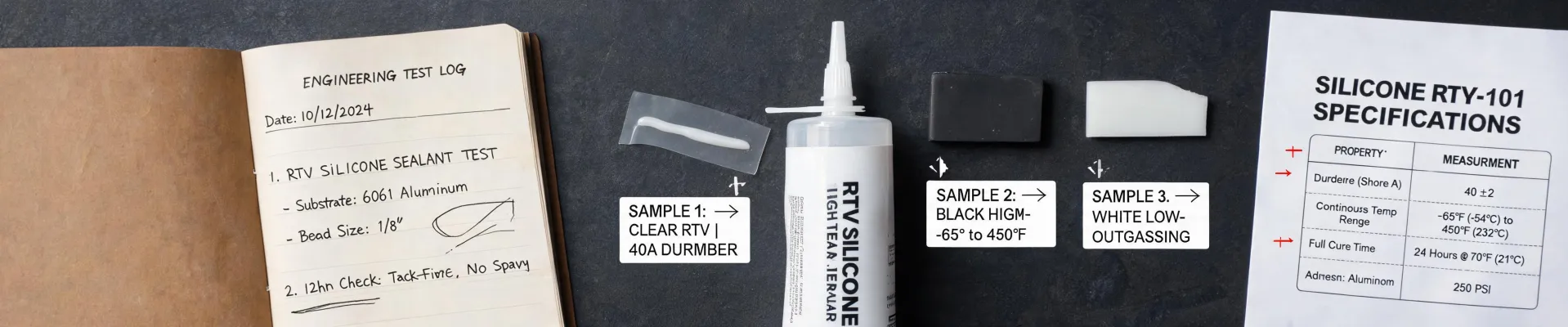
If after that you’re still stuck, grab a sample of the two most likely candidates and test them side-by-side. I always keep a small inventory of 3–4 different Momentive products on my shelf so I can run a quick test before committing to a full order. That alone has saved me from ordering the wrong product at least 4 times.
Prices as of January 2025: a quart of platinum-cure RTV silicone for molds runs about $35–$60; a tube of foam-safe sealant is $8–$15; a 1-lb jar of gel silicone is $45–$80 (verify current rates). But the cost of choosing wrong is far higher.
Look, I’m not saying budget options are always bad. I’m saying they’re riskier. A small investment in the right Momentive silicone upfront will save you the headache of rework—and maybe a conversation with your VP that you’d rather not have.