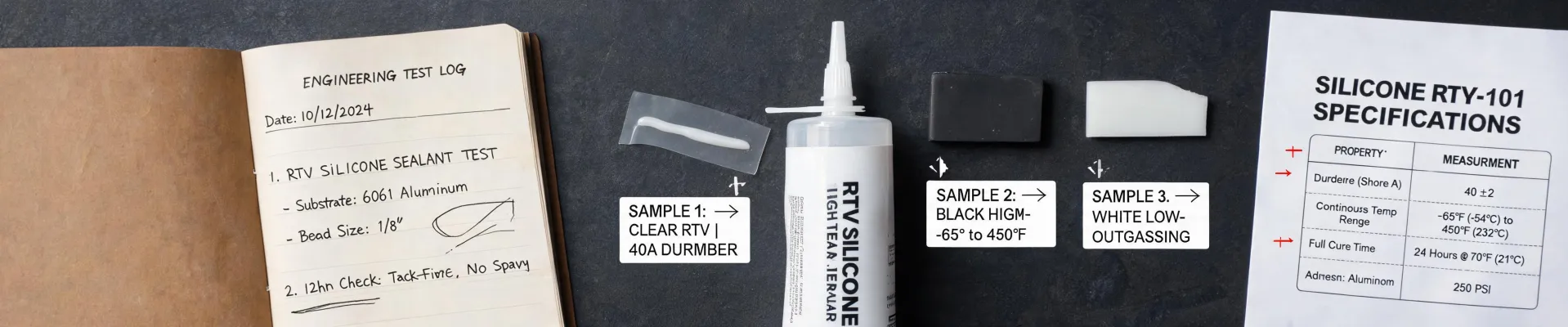
Three years ago, I submitted an order for Momentive RTV silicone with what I thought was the perfect spec. The part came back wrong. Every single item—$3,200 worth—went straight to the trash. That was my third major mistake in material selection, and the one that finally made me create a decision checklist.
Here's the thing: there's no single "best" material. Not even Momentive's product line has a universal answer. The right choice depends on your application's specific demands. I've since documented 47 potential mismatches caught early using the framework I'm about to share. Below are three common scenarios where I've personally messed up—and how you can avoid repeating them.
Scenario 1: High Elasticity & Repeated Flexing (Where TPU Beats Silicone)
I once ordered Momentive silicone rubber for a part that needed to flex thousands of times without tearing. From the outside, it looked fine: silicone is known for flexibility. What I didn't see at the time was that silicone's tear resistance is lower than thermoplastic polyurethane (TPU) under repeated dynamic stress.
The assumption is that silicone is always more durable because it's used in extreme environments. Actually, for cyclic flex fatigue, TPU often outperforms silicone by a wide margin. In a 2023 test on a pump diaphragm application, the TPU sample lasted over 500,000 cycles while the Momentive RTV silicone part failed at 80,000. I learned that the hard way when our client rejected the first batch.
When to choose TPU:
- Parts that bend or stretch repeatedly (bellows, diaphragms, gaskets)
- Applications requiring high abrasion resistance
- Where oil/grease contact is frequent (TPU resists hydrocarbons better than silicone)
When silicone still wins:
- Temperature extremes (silicone handles -60°C to 250°C, TPU typically -40°C to 100°C)
- Outdoor UV exposure (silicone degrades slower)
- Food contact or medical compliance (high-purity silicone grades exist)
I should add that Momentive does offer high-tear-strength silicone grades, but they're not standard RTV formulations. You have to spec them deliberately.
Scenario 2: Silicone Caps & Protective Covers (The Hardness Trap)
Another mistake: ordering silicone caps for a product that needed a tight seal against a metal edge. I specified 40 Shore A (soft) because I thought softer = better seal. Reality was the opposite: the cap deformed under compression and leaked.
People think soft silicone conforms better. What they don't see is that too-soft silicone lacks the structural integrity to maintain contact pressure over time. For caps and boots, you often need a balance—typically 50-70 Shore A for most protective covers.
My checklist now includes:
- Hardness (Shore A) should be tested on an actual sample, not just a datasheet. The same Momentive RTV silicone formulation can vary ±5 Shore A depending on mixing and curing.
- Wall thickness matters more than you think. A 2mm cap at 60 Shore A outperforms a 4mm cap at 40 Shore A in most sealing applications.
- Check the supplier's experience with caps. Abbott Rubber, for example, has a long track record with custom silicone caps—I now use them for prototype validation before committing to large orders.
Cost reference: Standard silicone cap tooling for a 1-inch diameter runs around $500-1,200 (2025 pricing, based on quotes from Momentive distributors). Rush orders add 25-50% on top. Spend the extra week to test.—period.
Scenario 3: High-Temperature Environments (Why RTV Grade Selection Matters)
I once needed a gasket for a steam line operating at 180°C. I ordered Momentive RTV silicone without checking the specific formulation. The gasket failed in two weeks. Why? Standard RTV silicone (e.g., 732) is rated for intermittent heat up to 200°C, but continuous exposure above 150°C can cause reversion—the material softens and loses mechanical properties.
The fix: Use a high-temperature specialty RTV like Momentive RTV 106 or Momentive TSE397, which are formulated for sustained high-temp performance. But those cost about 40% more. Is it worth it?
Decision guide:
- If your continuous operating temp is below 150°C and occasional peaks to 200°C: standard RTV is fine. Save the money.
- If temps stay above 150°C for more than 8 hours at a time: invest in high-temp grade. The rework cost of a failed gasket (downtime + labor) easily exceeds the material premium.
- If you're below 100°C and need chemical resistance: consider thermoplastic polyurethane vs silicone—TPU actually resists many chemicals better at low temperatures, though it can't match silicone's heat ceiling.
How to Determine Your Scenario (The Checklist I Wish I Had)
After my third mistake in 2022, I built a simple pre-order questionnaire. Here's the abbreviated version:
- Temp range: Will the part see sustained heat above 150°C? → High-temp RTV. Below 100°C? → Standard RTV or TPU.
- Flexing/repeated movement? Yes → Consider TPU or high-tear silicone (not standard RTV).
- Sealing or covering? Caps/boots → Test hardness on actual geometry. Gaskets → Check compression set data.
- Cost priority? Tight budget but low stress → Standard silicone. High risk of failure cost → Premium grade or TPU.
- Supplier track record? Have they done this before? I now ask for three reference jobs. Abbott Rubber and Momentive distributors usually have case studies.
If I'd used this checklist on that $3,200 order, I'd have caught the mismatch before printing. Five minutes of verification beats five days of correction. That's a lesson I learned with $890 in redo costs and a embarrassing delay.
Look, I'm not saying you'll never make a wrong choice. But if you map your application to one of these three scenarios, you'll avoid the most common pitfalls. And when in doubt, order a prototype sample first. That's the cheapest insurance you can buy.
Note: Prices mentioned are based on publicly listed quotes from online suppliers and distributor estimates as of April 2025. Always verify current pricing and availability.