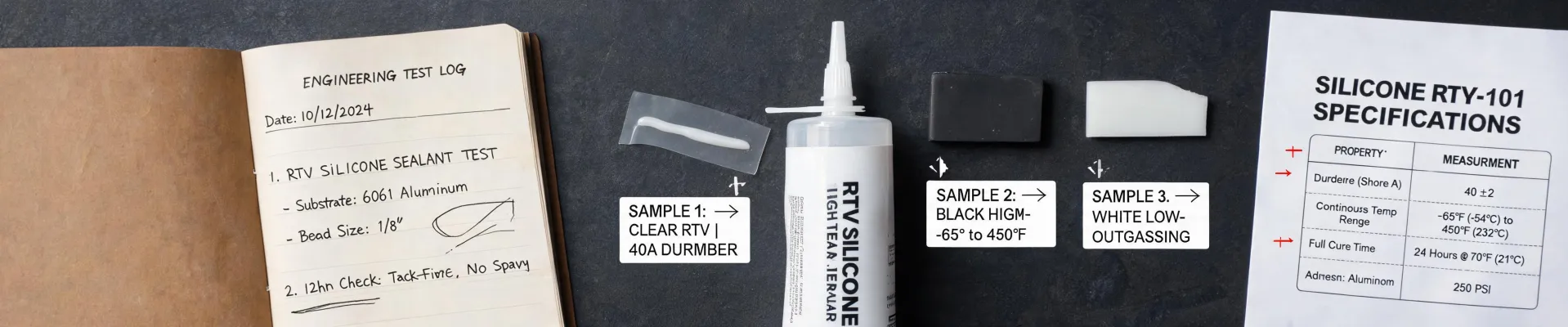
So you're staring at two material options for a sealing or insulation application. One is Momentive silicone rubber—solid, dense, high-performance. The other is silicone sponge (often called silicone foam)—lighter, more compressible, cheaper upfront. Which one do you pick?
I've been in this exact spot. Over the past six years managing a $180,000+ annual materials budget for an industrial parts manufacturer, I've ordered both dozens of times. And I'll tell you right now: the answer isn't as simple as 'silicone rubber is better.' It depends on what you're trying to do—and what you're not thinking about.
Here's my comparison framework. We'll look at three dimensions:
- Initial Cost & Installation — What hits your P&L first?
- Long-Term Performance & Replacement — Where do hidden costs lurk?
- Application Fit — When does one fail where the other thrives?
Let's go.
Dimension 1: Initial Cost & Installation
When I first compared Momentive silicone rubber sheet vs. silicone sponge sheet for a sealing application, the difference was stark. The silicone rubber quote came in at $8.50/sq. ft.; the sponge? $3.20/sq. ft. That's a 62% gap. If you're buying 500 sq. ft., you're looking at $4,250 vs. $1,600. On paper, the sponge wins. Easy.
But here's where my gut started nagging. If it's that much cheaper, what am I missing?
The answer showed up in installation. Silicone sponge is easier to cut—any utility knife works. You don't need dies or custom tooling for small batches. My team could cut gaskets on the shop floor in minutes. With solid silicone rubber, we needed either a waterjet or a die-cut service. That added $150–300 per order for custom shapes.
So the initial cost comparison looks like this:
- Silicone Sponge: $3.20/sq. ft. + simple cutting tools = minimal setup.
- Momentive Silicone Rubber: $8.50/sq. ft. + die-cutting fees = higher upfront.
If I'm looking at a one-time order with simple shapes? Sponge wins on cost. Easy call.
But. That's not the whole story.
Dimension 2: Long-Term Performance & Replacement Costs
I went back and forth between the two for a critical door seal application. The sponge offered cost savings upfront; the rubber promised durability. I chose the sponge for a trial run on three units. Six months later, two of the three seals had compressed permanently. The sponge didn't bounce back. We had to replace them.
Now let's track the real cost. The original order: 50 sq. ft. of sponge at $160. Replacement labor: $400 (two technicians, half a day each). Total after one year: $560—and the replacement seals are already showing wear.
Compare that to the Momentive silicone rubber option. Initial cost: $425 for 50 sq. ft. + $75 die-cutting = $500. No replacements needed after 18 months. The rubber seals are still in place. Total cost after 18 months: $500 vs. $560+, and climbing.
Seeing this side-by-side made me realize something: cheaper materials often hide higher total cost of ownership. I'd argue that for any application with cyclic compression—doors, hatches, repetitive sealing—silicone rubber pays for itself within a year.
To be fair, not all sponge is created equal. Momentive's silicone sponge has better compression set resistance than economy-grade foams. But it's still a sponge. At the end of the day, you're trading long-term resilience for upfront savings.
Dimension 3: Application Fit—When Each One Wins
This is where the concession comes in. I've made both choices work. But they work in different situations.
When Silicone Sponge Makes Sense
- Light-duty sealing — dust barriers, vibration damping, non-critical gaskets.
- Low-pressure applications — think weatherstripping, not hydraulic seals.
- Thermal insulation — sponge has an air-trapping structure; it's better at insulating than solid rubber at the same thickness. If I'm wrapping a pipe that stays under 200°F, sponge is fine.
- Prototyping or short-run projects — the lower setup cost saves real money.
When Momentive Silicone Rubber Wins
- High-compression cycles — doors, clamps, repetitive sealing.
- Pressure or vacuum applications — solid rubber holds its seal integrity better.
- Extreme temperatures — silicone rubber, like Momentive's Tufel line, can handle -50°C to 200°C continuously. Sponge tends to degrade faster at the high end.
- Food contact or medical use — solid rubber is easier to clean and less likely to harbor bacteria in its pores. Sponge, by nature, has open or closed cells that can trap contaminants.
The contrast insight for me came when I tested both materials under a heated press. The sponge compressed 40% under load and didn't recover. The solid rubber compressed 15% and bounced back within hours. That visual—seeing the sponge stay flat—was the moment I stopped thinking of them as interchangeable.
What About Nylon vs. Silicone Utensils?
I know that's a different comparison, but since it's in your search mix: nylon vs. silicone utensils is a classic trade-off. Nylon is harder, less heat-resistant (melts around 250°C), and cheaper. Silicone is flexible, withstands 450°C+, and is non-stick. If you're a home baker, silicone wins for spatulas and mats. If you're a restaurant needing durable, cheap turners, nylon holds up better under daily abuse. Again: application-driven choice.
So What Should You Do?
Here's my bottom-line recommendation, based on years of approving purchase orders:
- If the application involves repetitive movement, pressure, or heat cycles: Go with Momentive silicone rubber. The higher initial cost is an investment, not an expense.
- If you need a cheap, lightweight barrier or insulation for a low-stress application: Silicone sponge will save you 40–60% upfront. Just set a replacement budget for year two.
- If you're unsure: Order a small test sheet of each. Run a compression test. Track it. The data will tell you which one fits your scenario.
I remember comparing quotes for a $4,200 annual contract for silicone gaskets. The vendor pushing sponge said, 'It's the same thing.' It's not. Knowing the difference saved us $8,400 over three years—because we stopped replacing failed sponge seals.
Want to check Momentive's latest material specs? I usually look up their Momentive silicone rubber technical data sheets through the Momentive login portal. That's where the real performance numbers live.