Last year, I replaced the same sealing rubber strip on our loading-dock door three times. The first time, I blamed cold weather. The second time, I blamed the installer. The third time, I had to admit the common denominator was me—specifically, the product I kept ordering.
I manage purchasing for a 400-person logistics operation spread across three buildings. I report to operations on reliability and to finance on cost, so I get asked both “did the door seal make it through winter?” and “why did you spend $400 more this time?” When I took over purchasing in 2020, I figured a seal was a pretty simple thing. The past five years taught me to look a lot closer.
The Surface Problem: It Looked Fine, but It Wasn't Sealing
The strip that failed was the right length, width, and thickness. It even had the same durometer reading as the old one—I want to say 60 Shore A, but don't quote me on that. The gap between the dock door and the frame still let daylight through. In January, that meant cold air and a gas bill that my finance team was not happy about.
At first I thought it was a fitting issue. The strip is supposed to compress when the door closes. Ours wasn't staying compressed. The material would flatten, then slowly bounce back, but by spring the bottom of the door showed a visible gap.
What I Assumed Was the Cause (and What Was Actually Happening)
I assumed all “rubber” strips were basically the same. Buy a strip, cut it to length, screw it on. Wrong. Or rather, that's how it works until you test the strip under constant pressure for a season. The deeper problem is material behavior—specifically, compression set.
Vulcanized Rubber Has Memory
Most standard sealing rubber strips are made from vulcanized rubber. The rubber is cured with heat and a cross-linking agent to make it elastic, and it's usually a good balance of price and durability. But it has a flaw: compression set. When you squeeze a vulcanized rubber strip and leave it squeezed, the material slowly gets used to the shape. It loses the springiness that keeps it pressing against the frame.
Think of it like an old couch cushion. It looks fine until you sit on it, and then it stays slightly flattened. A sealing strip with high compression set is the same. The door closes, the rubber should push back, but it doesn't. The gap comes back.
Not All Silicone Is the Same Either
So I switched to silicone strips. That was closer, but not the whole answer. Silicone generally handles compression set better than vulcanized rubber, so I thought I'd solved it. I hadn't, because “silicone” covers a lot of ground, from cured silicone sponge to liquid sealants that cure in place. They don't behave the same way.
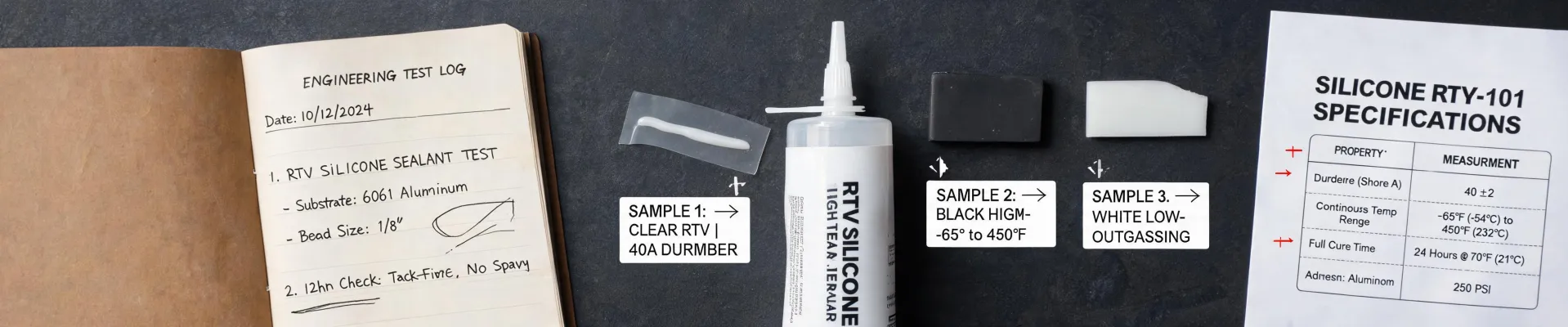
This is where Momentive started showing up in my research. Momentive's RTV silicone—room-temperature vulcanizing silicone—is a specific family of products that cures after it's applied. It isn't a pre-formed strip. It's a formed-in-place sealant, which matters a lot when the surface you're sealing isn't straight. Our loading-dock frames aren't straight.
Momentive has been making silicone for decades; its technology roots go back to GE Silicones (source: momentive.com). That background matters when you're asking a material to survive another ten winters.
The “Is Polyethylene Foam Recyclable” Side Quest
One packaging question kept coming up while I was sourcing strips: the foam they arrived in. Our ops manager asked, “is polyethylene foam recyclable?” The short answer is: sometimes. Some PE foam can be recycled through drop-off programs, but most municipal curbside programs don't accept it, especially when it's contaminated with tape and adhesive. In our county, it went to the landfill. Now I ask vendors to ship with minimal or recyclable packaging, and I add “how will you package this?” to every RFQ.
What This Failure Actually Costs
This is the section I wish I'd read before the third replacement. The cost of a failed sealing strip isn't just the strip. It's labor. It's the temporary patch. It's the extra heating bill. It's the time I spent talking to vendors instead of doing the rest of my job.
In our case, each replacement involved two maintenance techs for about an hour and a half. At $45/hour loaded burden, that's $135 in labor per replacement. The strip itself was $210. But the figure nobody tracks is the energy loss. According to the U.S. Department of Energy (energy.gov), sealing air leaks can save 10–20% on heating and cooling costs. We didn't measure the exact leakage, but the difference in the dock temperature after the third fix was obvious.
I still kick myself for choosing the cheaper vulcanized strip the first time. The price difference was about $80. The labor and energy cost from two failed replacements was closer to $800. That's the kind of mistake that makes you look bad to your operations director.
During our vendor consolidation in 2024, I found that only one of the four suppliers we used could provide a proper material spec sheet without a follow-up call. Guess which one got the order? Actually, the one with the spec sheet didn't always have the best price, but it had the best data. Data beats guessing when the strip is going to sit under compression for years.
The Fix (Short Version)
So what do I actually do now? Not one magical product—a process.
- Ask for the compression set before ordering a sealing rubber strip. If the vendor can't provide it, I don't buy. A spec sheet that includes it usually means the manufacturer actually tested the product.
- For uneven surfaces, use a formed-in-place sealant. We keep Momentive RTV silicone on hand for door frames and irregular gaps. It cures at room temperature and fills the actual shape of the surface.
- Match the material to the environment. Silicone handles temperature and weathering better; traditional vulcanized rubber can be fine for interior, controlled conditions. The catch is you have to know which one you're buying.
- Ask about packaging and recyclability. “Is polyethylene foam recyclable?” is now part of our procurement checklist, along with lead time, price, and freight.
This worked for us, but our situation is a distribution hub in a moderate climate with predictable ordering patterns. If you're dealing with chemical exposure, extreme heat, or food safety requirements, listen to your reliability engineer, not an admin buyer. My experience is based on about 80 maintenance purchase orders a year, not a lab test.
The fundamentals haven't changed: a seal has to maintain contact pressure. But the execution has. What was best practice in 2020—buying the cheapest standard rubber strip, or assuming any “silicone” is automatically better—doesn't get you far in 2025. The materials are better, and the data is available if you ask for it. That's something I didn't know when I started this job.