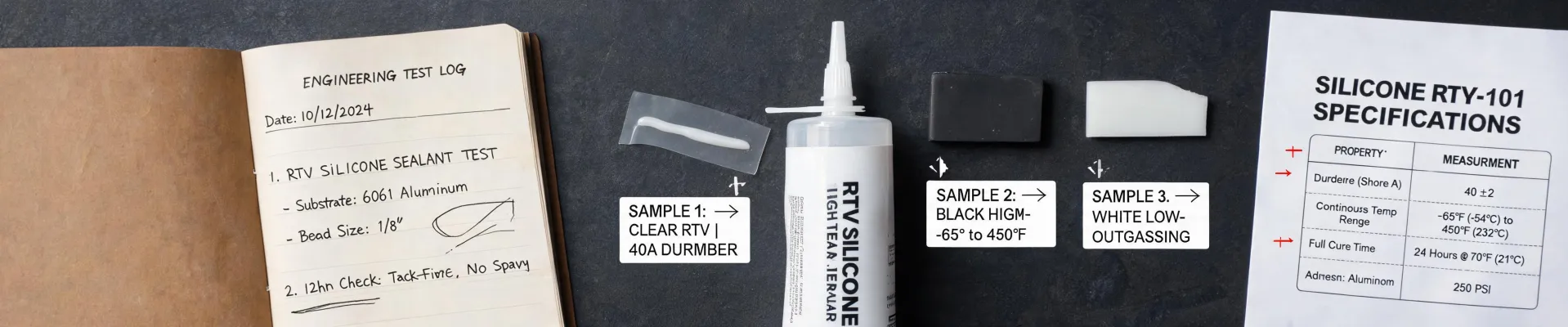
If you're tasked with sourcing silicone materials for your company—sealants, rubber sheets, foam gaskets—you probably have a standard process: get a few quotes, check the specs, compare prices. That's how it should work. But after managing purchasing for an industrial manufacturing firm over the last five years (about $2M annually across 12 vendors), I've learned that the simplest approach often misses the most critical details. It's tempting to think you can just compare unit prices. But identical specs from different vendors can result in wildly different outcomes.
So I put together a checklist. It's not complicated. But following it has saved me from embarrassing delays, blown budgets, and materials that didn't perform as sample. I'll walk through the five steps I use now, every time.
Step 1: Verify Material Composition, Not Just the Spec Sheet
This sounds obvious, but I've been burned by trusting a data sheet too literally. A vendor once quoted a silicone rubber sheet as '40 Shore A'—it was 45 on our durometer. The difference meant our gasket design didn't compress correctly.
What I do now: Ask for a certified test report or in-house mill certificate for the specific lot. Not the generic one. Some vendors will provide a 'typical properties' table that covers a whole product range. That's not good enough. Insist on data for the batch you're ordering. It takes an extra email, but it catches inconsistencies before they become problems.
Here's something vendors won't tell you: a 'standard' spec often has a tolerance range. For silicone foam, density can vary by ±10% and still be 'within spec' for certain grades. That matters if you're engineering a tight seal. Ask for the tolerance range for the specific property you care about—for me, it's usually compression set and tensile strength. Plenty of suppliers can give you a tighter range if you pay a small premium on larger orders.
Step 2: Sample, Then Validate Under Your Actual Conditions
Most of us ask for samples. But I've learned to test them not under ideal lab conditions, but under the worst-case conditions the material will face in our facility. That means: your temperature extremes, your chemical exposure, your cycle time for assembly.
I once approved a silicone foam sample that performed perfectly at 20°C. But our production line regularly hits 65°C near the ovens. The foam softened and the adhesive failed within a week. That cost us a rework order—about $2,400 in lost labor and materials.
Now I write a mini-test protocol for every new material: 'Test at 70°C for 24 hours with exposure to cutting oil.' If the sample survives that, it's likely good enough. If they can't provide a sample for destructive testing, I move on. No exceptions.
Quick tip: Request a small production run (like 50-100 units) alongside the sample. The sample might be handcrafted. Production parts can be different. That's been my experience more than once.
Step 3: Validate Logistical Capability (Not Just Price)
You can get a great price, but if the vendor can't deliver on time or the packaging makes handling a hassle, it's not saving you money. Looking back, I should have paid more for a slightly higher-priced vendor who used proper labeling and consistent lead times. At the time, the standard delivery window seemed safe. It wasn't.
My checklist now includes questions like:
- What is their lead time for a standard order vs. a rush order? (Rush fees are worth it—at least, that's been my experience with deadline-critical projects.)
- Do they ship in reusable containers? We've consolidated orders for 60-80 shipments a year and saved about $600 annually on disposal costs.
- What is their process for issuing invoices and certificates of compliance? The vendor who couldn't provide proper invoicing cost us $2,400 in rejected expenses because finance couldn't match the order.
I ask for a sample invoice before committing. If they can't provide a clear one, that's a red flag for my accounting department.
Step 4: Check Their Market Reputation for Quality Consistency
Price and lead times are easy to compare. Consistency is harder to see upfront. In my experience, a vendor with a legacy—like one that came out of a company with a 60-year track record (think GE heritage)—tends to have more mature quality control. But that's not a guarantee.
I spend about 15 minutes on industry forums and LinkedIn. Look for recent complaints about 'batch inconsistency' or 'off-spec material.' Even one or two recent complaints from customers with similar applications to yours is a warning sign.
What most people don't realize is that 'standard turnaround' often includes buffer time that vendors use to manage their production queue. It's not necessarily how long YOUR order takes. A consistent supplier will be able to give you a realistic delivery window—not the theoretical best-case one.
Step 5: Don't Skip the Fine Print on Warranties and Returns
I glossed over this for years. Then we got a batch of RTV silicone that was contaminated. The vendor's warranty only covered the material cost, not the cost of labor, lost production, or rework. We were out about $1,200 for that one order.
Now I check:
- What's the warranty period? (30 days? 90 days? One year?)
- What does it cover—just the material, or consequential damages too?
- What's the process for a return? Are they responsive, or do you get a generic email address?
If they're not willing to discuss warranty terms before the order, it's a sign they might not stand behind their product.
Quick Reference Checklist (Print This)
Here's my final checklist. I keep this in my notebook.
- Material: Verified composition and tolerance for key properties (compression set, density, shore hardness).
- Sample: Tested under realistic worst-case conditions (temperature, chemical exposure).
- Logistics: Lead times, packing, invoicing process confirmed.
- Reputation: No recent red flags on consistency from similar buyers.
- Warranty: Clear terms covering labor/rework costs if material is defective.
One last note: Prices as of early 2025; verify current rates. That checklist isn't perfect. It's based on what I've learned the hard way, so hopefully you don't have to.