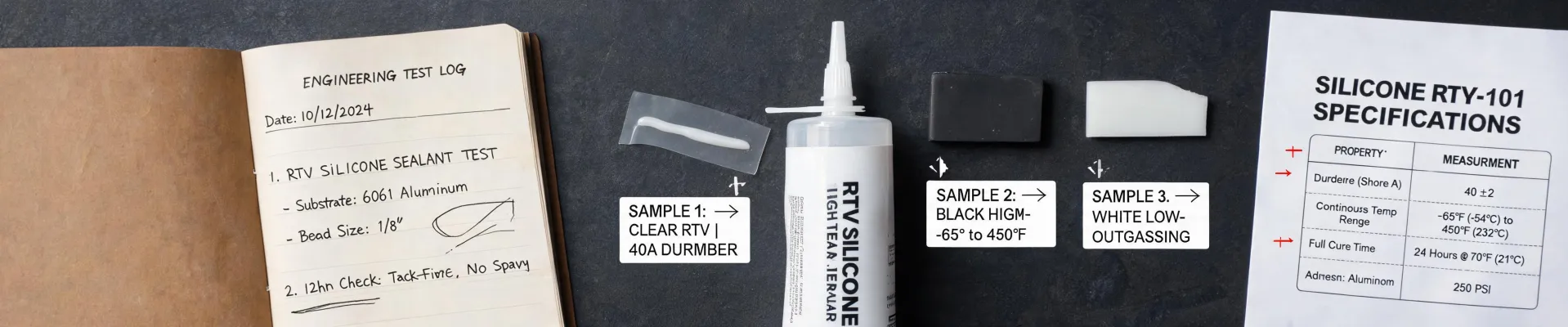
So you're trying to figure out if Momentive silicone products are the right call for your project. Or maybe you're just trying to understand why the spec sheet says 'silicone rubber' but the sample feels like foam. I've been in this seat—triaging material decisions for clients who are already on a tight timeline. Here's the stuff I wish someone had told me upfront.
1. What's the difference between Momentive silicone sealants and silicone rubber?
This is the most common mix-up I see. People call anything that comes in a tube a 'sealant' and anything that's a solid sheet or gasket 'rubber.'
Here's the real distinction: sealants (like Momentive's RTV silicone) cure from a liquid or paste into a flexible solid. They're used for filling gaps, bonding different substrates, and creating a weatherproof seal. They start as a goo and end as a solid.
Rubber, on the other hand, is already formed. A Momentive silicone rubber sheet or an O-ring is a finished solid material. You cut it, stamp it, or mold it into the final shape.
Think of it this way: a sealant is a solution for a joint that moves or has a gap. A rubber sheet is the answer when you need a durable, flexible barrier that fits a specific dimension.
Honestly, I'm not sure why the industry doesn't make this clearer on spec sheets. My best guess is that the term 'silicone' overshadows the form factor. If you're sealing a seam, you need a sealant. If you're making a gasket for a housing unit, you need the rubber.
2. When should I use Momentive silicone foam instead of solid silicone rubber?
This one trips up a lot of engineers, especially in prototyping. I remember a call in March 2024 where a client had a vibration issue in an enclosure. They'd spec'd a solid rubber gasket. It worked, but the vibration was causing micro-cracks in the PCB. The fix? A silicone foam gasket.
Momentive silicone foam is compressible. It’s a closed-cell structure (mostly, depending on the grade). This means it's better for:
- Vibration Dampening – It absorbs energy that a solid rubber would transmit.
- Sealing uneven surfaces – Because it compresses more easily, it fills gaps better than a rigid solid.
- Thermal insulation – The trapped air in the foam cells is a great insulator.
So, rule of thumb: Use solid rubber for structural support or where you need high tensile strength. Use silicone foam for cushioning, sealing against rough surfaces, or dampening vibration. Foam is a game-changer for EMI shielding gaskets, too.
3. Okay, but is Momentive silicone basically just a fancy 'rubber bong' material?
I've been asked this by procurement folks who've Googled 'rubber bong' and landed on a silicone product. That's a specific application—yes, high-grade silicone is used for kitchenware and smoking accessories because it's inert, heat-resistant, and doesn't leach chemicals.
But here’s the knowledge gap: The silicone used in a consumer rubber bong is usually a lower-durometer (softer), food-grade LSR. It's not the same formulation as the high-strength silicone rubber used for industrial gaskets, electrical insulation, or aerospace seals.
Momentive makes materials across that whole spectrum. Just because it's ‘silicone’ doesn't mean it has the same tensile strength or temperature rating. A general-purpose rubber sheet is not the same as a specialized silicone elastomer designed for 300°C continuous heat. Always check the datasheet for the specific property you need (tear strength, compression set, dielectric strength).
4. What's the deal with 'foam board Michaels'—is that the same thing?
No, but I see this search term come up, and it's a point of confusion. 'Foam board' from a craft store (Michaels) is typically polystyrene or PVC foam. It's rigid, brittle, and for non-structural projects like model building or mounting photos.
Momentive silicone foam is entirely different. It's a rubbery, flexible foam. You can't cut it with a standard utility knife and get a clean edge like you do with craft foam board. It's for engineering applications, not art projects.
If you're looking for a foam for an industrial prototype, the search term you want is 'silicone foam gasket material' or 'closed cell silicone sponge.'
5. Polyurethane vs. Silicone Rubber: Which one should I pick?
This is a classic debate. I've tested both. Here’s what I’ve learned from actual failures:
| Property | Polyurethane Rubber | Silicone Rubber (Momentive) |
|---|---|---|
| Temperature Range | -40°C to 120°C (limits) | -60°C to 230°C+ (excellent) |
| Abrasion Resistance | Excellent | Good to Fair |
| UV / Weathering | Poor (degrades) | Excellent |
| Tensile Strength | Very High | High |
| Chemical Resistance | Good (oils, fuels) | Fair (swells in hydrocarbons) |
Here's my rule: If you need to survive extreme temperatures or outdoor UV exposure for decades (think solar panel gaskets or building expansion joints), pick silicone. It's a no-brainer.
If you need to survive constant abrasion or fuel immersion (a hydraulic piston seal or a conveyor belt), pick polyurethane.
People think expensive materials deliver better quality. Actually, materials that deliver the right properties for the job can command a premium. Polyurethane isn't 'cheap'—it's just cheaper than silicone in the wrong application. The assumption is that silicone is always better. The reality is they are optimized for different enemies.
6. What about Momentive silicone sealants compared to acrylic or urethane?
Quick reference:
- Acrylic sealants – Cheap, paintable, but shrink and crack over time. For interior, non-critical use. Not for wet areas long-term.
- Urethane sealants – Very strong adhesion, paintable, but hard to clean up and deteriorate in direct UV. Great for concrete joints (driveways).
- Silicone sealants (Momentive) – Excellent flexibility, UV resistance, adhesion to glass and ceramics. Not paintable (most formulas). Best for outdoor, bathrooms, and expansion joints.
If you're sealing a window on a south-facing wall, use silicone. 5 minutes of verification on the cure time beats 5 days of re-caulking a failed urethane joint later.
7. How do I choose the right 'hardness' for my silicone part?
Hardness in rubber is measured on the Shore A scale. A higher number is harder. Here’s a ballpark guide based on common applications:
- Shore 20-40 A – Very soft. Think 'rubber bong' or squeegee blades. High friction, high flexibility. Good for sealing light-pressure gaps.
- Shore 50-70 A – Standard industrial rubber. O-rings, gaskets, and automotive hoses. The 'sweet spot' for general purpose.
- Shore 80+ A – Hard rubber. Rollers, wear strips, structural pads. Very stiff, low compression set.
Again, this worked for us, but we're a mid-size B2B operation. If you're dealing with FDA food-contact or a cryogenic application, the calculus might be different. Always check the datasheet for compression set values—that's how you know if it will hold its shape over time.
Pricing is for general reference only. Actual prices vary by vendor and volume. As of early 2025, we saw silicone rubber sheets ranging from $35 to $90 per sheet (1/8" thick, 24"x24"), depending on the Shore hardness and profile (Source: internal vendor quotes, January 2025).