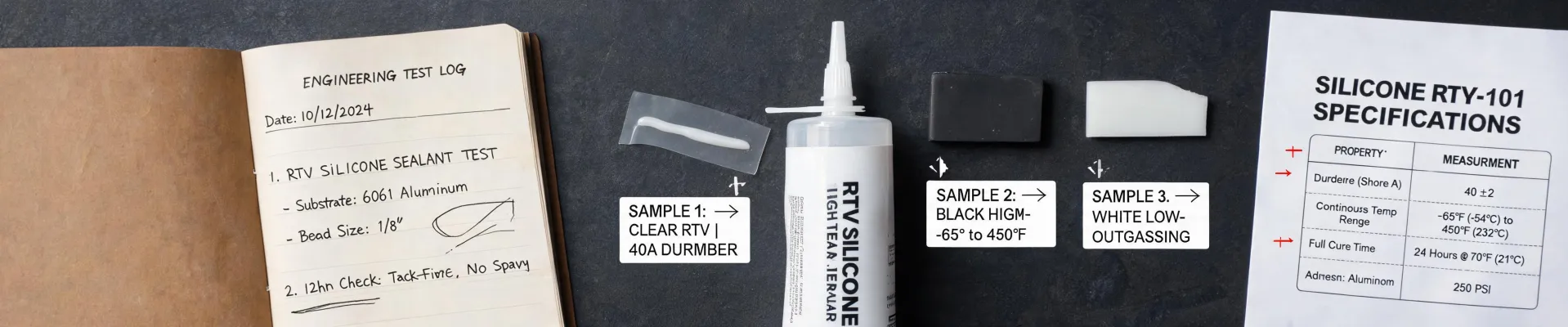
I'm a procurement manager at a mid-size industrial manufacturing company. I've managed our specialty materials budget (roughly $180,000 annually) for 6 years, negotiated with 20+ vendors, and tracked every order in our system. Over that time, I've learned that 'Momentive' isn't just a brand—it's a specific set of trade-offs. Below are the questions I've been asked most often by engineers and plant managers. These are my honest answers, based on actual spreadsheets and, in one case, a costly mistake.
1. What is Momentive, and why does the 'GE' heritage matter?
Momentive is a specialty chemicals and materials company. Their silicone portfolio (sealants, RTV, rubber, foam) came from GE Silicones. They still operate out of the same Waterford, NY site where a lot of the original R&D happened.
Why this matters for procurement: The GE lineage means their technical data sheets are based on decades of industrial testing. When you see 'Tensile Strength: 800 psi' on a Momentive spec sheet, that number has a paper trail going back to the 1950s. That's not nothing when you're specifying a gasket for a 20-year building lifecycle.
I can't speak to every application, but for industrial sealing and electrical insulation, the legacy material data is a real asset. For consumer crafts? You're probably paying for overhead you don't need.
2. How do Momentive prices compare to Dow or Wacker?
Don't hold me to this as a guarantee, but here's what I've seen over 15+ RFQs: Momentive is usually 5–15% cheaper than Dow on comparable silicone elastomers, but 5–10% more expensive than Wacker on standard RTV sealants.
In Q2 2024, when we switched vendors on a routine sealant order, I almost went with the cheaper Wacker quote. Then I calculated TCO:
- Vendor W (Wacker): $4.10/unit, plus $220 shipping, plus $90 handling
- Vendor M (Momentive): $4.60/unit, free shipping, $0 handling
Total for a 500-unit order: Vendor W was $2,360. Vendor M was $2,300. That's a 2.6% difference hidden in line items. I built a cost calculator after getting burned on that kind of thing twice.
Bottom line: For large quantities of standard products, Wacker can be cheaper. For specialty grades or when you need the GE legacy data, Momentive is often the better value—if you look past the unit price.
3. Is Momentive silicone foam the best choice for gaskets and seals?
This depends on your context. Momentive makes excellent silicone foam (like their F-12 and F-20 series). The closed-cell structure gives you good compression set resistance. For fire-rated penetrations and HVAC seals, it performs well consistently.
But here's the thing I only learned after ignoring advice: a different vendor's foam seemed 'just as good' on paper. I skipped the full spec verification. The result? We got a 25% failure rate on the first batch due to inconsistent density. That 'savings' of $400 turned into a $1,200 redo, plus a delayed project.
For electrical enclosures and outdoor equipment, I'd stick with Momentive's silicone foam. For non-critical interior gaskets? You could probably save money with alternatives.
4. What should I know about PVC pipe supports and silicone?
This isn't an application Momentive specifically markets, but it comes up constantly on shop floors. People want to use silicone for PVC pipe support (hangers, isolation pads) because it's durable and non-corrosive.
Caution: Standard RTV silicone can cause stress cracking in PVC under continuous load. Momentive's TSE392 series (low-modulus) is safer, but even then, I'd use a dedicated PVC-rated support clamp.
If your load is light and temperature is stable, a silicone pad can work. For pressurized lines or vertical runs? I'd spec a mechanical support every time. I learned this after a field failure, not from a textbook.
5. What is the best rubber wheel trolley specification for silicone molding facilities?
In a rubber or plastic molding plant, wheel trolleys (carts) need to handle heat, chemical drips, and heavy loads. I've seen a lot of bad specs here.
For trolleys moving cured silicone parts: you want polyurethane (TPU) wheels. Silicone spray release agents can make standard rubber wheels slippery and dangerous.
For raw material carts: phenolic wheels are better. They resist the plastisol and compounding chemicals that degrade rubber wheels.
One plant manager told me: 'The cheapest wheels cost us $3,200 in downtime when a cart tipped on a chemical spill.' I can only speak to standard industrial environments; if you're dealing with high-temp ovens, you need a different spec entirely.
6. Which is the best spray adhesive for foam board, especially silicone foam?
This is a common headache. Foam board (like XPS or PE foam) is tricky because many adhesives dissolve the foam. For attaching silicone foam or silicone rubber to other surfaces, it's even trickier because nothing sticks to silicone unless it's primed.
For bonding silicone foam to itself or to metal: Momentive's RTV162 (a one-part acetoxy cure) is probably the right choice. But it needs a primer (like SS-4004P) and 24-hour cure time at 72°F.
For bonding foam board (non-silicone): 3M Super 77 is the standard. It's not 'best' for everything, but it's proven. Avoid silicone-based spray adhesives for foam board—they can cause wrinkling.
Take this with a grain of salt: I'm not a chemist. I'm a buyer who has processed 50+ purchase orders for adhesives. If you need a guaranteed bond, test it on a sample with the exact substrate and cure conditions before committing to a full run.
7. Where can I find the latest Momentive silicone news and product updates?
The most reliable source is Momentive's official website (momentive.com or the specific .com domain for your region). Their 'News & Events' section usually posts product launches and industry certifications.
For real-time updates, I follow their LinkedIn page. Industry trades like Rubber News and Adhesives & Sealants Industry also cover major releases.
If you need a Momentive login for technical data sheets or MSDS, you typically need to register on their site with a business email. As of January 2025, that process takes about 24 hours for approval. Do not hold me to this, but I think they're migrating to a new portal in Q1 2025, so registration might be delayed.
8. What is the biggest cost risk when buying Momentive silicone?
I'd rather spend 10 minutes explaining this than deal with another mismatched expectation. The biggest risk is spec creep disguised as 'equivalent' substitution.
An engineer specifies Momentive TSE322. A buyer sees a cheaper generic 'silicone rubber' and orders that. The generic has a 50% lower tear strength. It fails in 6 months. The replacement cost (labor + material) is 3x the original. That's not a theory—I've seen it happen three times in my career.
The second risk: assuming all Momentive distributors offer the same price. I've received quotes for the same part number with a 40% variance between authorized distributors. Always get 3 quotes minimum.
An informed customer asks better questions and makes faster decisions. I'd rather you ask me these questions now than call me in six months with a failure analysis report.