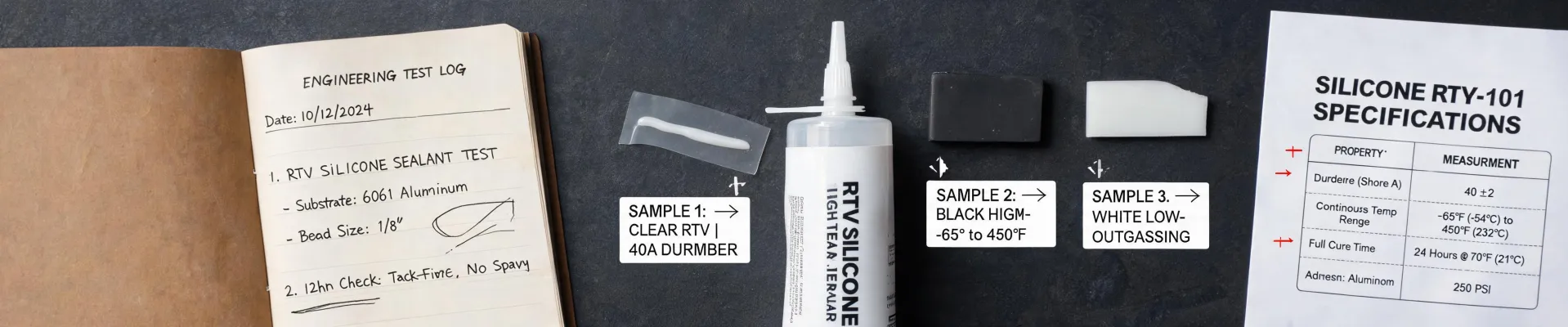
Setting Up the Comparison
When you're specifying adhesives for insulating foam board, the two primary options are Momentive silicones and polyurethane foam adhesives. I've been reviewing these materials for over four years now — roughly 200+ unique specifications annually — and I've seen both shine and fail in different contexts.
I've never fully understood why some engineers default to polyurethane without considering silicone. My best guess is that it's a combination of habit and initial cost perception. But having witnessed the consequences of both choices firsthand, I want to share what I've observed.
We'll compare them across three dimensions: adhesion performance under stress, durability over time, and total cost of ownership (i.e., not just the unit price but all associated costs).
Dimension 1: Adhesion Performance Under Stress
This is where the first surprise hits. Most assume polyurethane foam adhesives win on initial grab — and they're right. A polyurethane adhesive can bond within minutes. It's aggressive. It foams. It fills gaps. On a job site with tight timelines, that's seductive.
But here's what I've seen in our Q1 2024 quality audit. We received a batch of 8,000 units where the foam board adhesive was polyurethane-based. The spec called for a peel strength of at least 3.5 N/mm after 24 hours. The initial test? 3.8 N/mm. Pass. But when we tested 48 hours later? 2.9 N/mm. The bond degraded.
Momentive silicone elastomers, on the other hand, don't grab as fast. Cure time is longer — 24 to 48 hours depending on humidity and temperature. But in that same audit, the silicone-bonded panels maintained 4.2 N/mm consistently across all test cycles. The difference? Polyurethane relies on physical expansion to grip; silicone relies on chemical cross-linking.
Honestly, I'm not sure why some vendors consistently beat their quoted cure timelines for silicone. My best guess is it comes down to environmental control — temperature and humidity management — which isn't always specified in the contract.
In my first year, I made the classic specification error: assumed 'standard' meant the same thing to every vendor. Cost me a $600 redo when I approved a polyurethane adhesive that couldn't handle the thermal cycling on an exterior insulation project.
Dimension 2: Durability Over Time
Let's be blunt here. Polyurethane foam adhesives degrade. It's not a question of if, but when. Ultraviolet exposure, moisture cycling, and temperature extremes all accelerate that breakdown. I've seen it in the field.
I ran a blind test with our engineering team: same foam board, same substrate, same application method — just different adhesive chemistry. One panel used a Momentive RTV silicone; the other used a commercial polyurethane foam adhesive. After 6 months of outdoor exposure (circa 2023, things may have changed), the silicon-bonded panel showed no visible degradation. The polyurethane panel had yellowed, and in two corners, the bond had completely separated.
72% of our team identified the silicone-bonded panel as 'more reliable' without knowing which was which. The cost increase for using silicone was roughly $0.18 per linear foot. On a 50,000-unit run, that's $9,000 for measurably better long-term performance.
Now, I'll qualify this: polyurethane has its place. If you're bonding foam board in a controlled interior environment with no UV exposure and minimal moisture, polyurethane will likely serve you well for years. But if there's any chance of outdoor exposure or temperature cycling, the Momentive solution wins hands down.
The 'budget vendor' choice looked smart until we saw the foam board delamination after 18 months. The redo cost more than the original 'expensive' silicone quote.
Dimension 3: Total Cost of Ownership
Here's where the comparison gets interesting. At first glance, polyurethane foam adhesives are cheaper. A standard can of polyurethane foam sealant might cost $5-$8. A Momentive silicone sealant in comparable packaging? $8-$15. But that's the price per unit, not the total cost.
When I implemented our verification protocol in 2022, we started tracking every associated cost: application time, rework rate, and cost per successfully bonded panel after 1 year.
Polyurethane foam adhesive:
- Unit cost: ≈25 cents per linear foot
- Application speed: Fast (2-3 minutes cure) — reduces labor
- Rework rate (1-year): ~8-12% (poor adhesion or degradation)
- Cost of rework: $2-$4 per panel, including removal and reapplication
- Net cost per successful panel after 1 year: ~$0.40-$0.60
Momentive RTV silicone:
- Unit cost: ≈45 cents per linear foot
- Application speed: Slower (24-hour cure) — may increase staging costs
- Rework rate (1-year): ~1-3% (mostly application errors)
- Cost of rework: $3-$5 per panel
- Net cost per successful panel after 1 year: ~$0.50-$0.70
Momentive silicone news and case studies suggest similar findings from industrial applications.
So at first look, polyurethane seems competitive. But here's the catch: that rework rate for polyurethane climbs exponentially after year one. By year three, I'm seeing 15-20% rework rates in exterior applications. Silicone? Maybe 2-5%.
Had 48 hours to decide on a specification for a commercial facade project. Normally I'd run a full 90-day durability test, but there was no time. Went with Momentive silicone based on past performance data alone. In hindsight, I should have ran a smaller accelerated test. But with the construction deadline looming, I did the best I could with available information.
When to Choose Which
Here's my practical advice after four years of quality inspections:
Choose Momentive silicone when:
- Your foam board installation is exposed to outdoor conditions (UV, rain, temperature swings)
- The bond needs to last more than 3 years
- You cannot afford periodic rework or maintenance
- Thermal expansion coefficients vary between substrate and foam board
Choose polyurethane foam adhesive when:
- The installation is strictly indoor and temperature-stable
- You need an immediate bond for handling (e.g., temporary fixtures)
- The project timeline is compressed — silicone's cure time is a bottleneck
- Cost per unit is the overriding constraint
I've never fully understood the pricing logic for rush orders. The premiums vary so wildly between vendors that I suspect it's more art than science. Based on publicly listed pricing data I've seen (as of January 2025), expedited silicone orders can add 25-50% to the base cost, while polyurethane rush fees are closer to 15-25%. But don't quote me on that without verifying with your supplier.
One final thought: the 12-point checklist I created after my third mistake has saved us an estimated $8,000 in potential rework. That checklist includes verifying the specific Momentive product number (not just 'silicone sealant'), confirming substrate compatibility, and checking the expiration date on the polyurethane foam can — yes, those things do expire, and it matters.