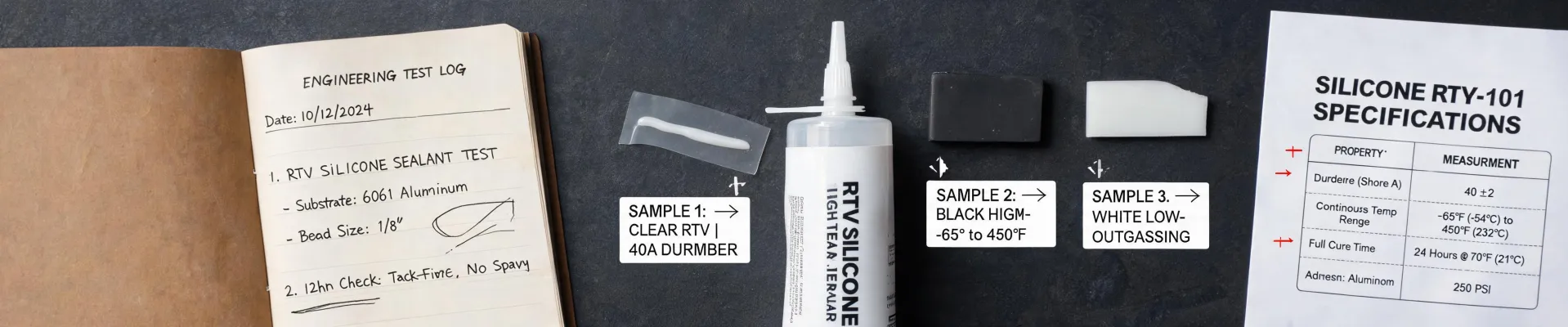
When I first started managing procurement for our mid-size manufacturing plant, I had one rule: lowest quote wins. It seems obvious, right? The finance team wanted cost savings, and the easiest way to show that was a lower number on the PO. I chased the cheapest Momentive silicone sealant supplier I could find, and I thought I was doing a great job. That was three years ago. Since then, I've audited over $180,000 in cumulative spending across 6 years of orders—sealants, rubber gaskets, foam rolls, the works—and I realized my initial approach was completely wrong. The lowest quote isn't the cheapest. It's often the most expensive.
The $4,000 Mistake I Made with a 'Cheap' Silicone Sealant
Let me give you a specific example. In Q2 2023, we needed a bulk order of a general-purpose Momentive silicone sealant. Vendor A, one of our established distributors, quoted $12.40 per tube, all-in. Vendor B, a new online supplier, quoted $11.20. I almost clicked 'buy' from Vendor B without a second thought. That's a $1.20 savings per tube, times 500 tubes. Simple math.
But something held me back. I decided to call Vendor B to ask about shipping. That's when the real numbers came out.
- Shipping: Not included. Additional $280 for standard ground.
- Minimum Order: I thought we met it, but their 'minimum for free setup' was $6,000. We were at $5,600. So, a $150 'small order' fee was added.
- Hidden Specs: The $11.20 price was for a standard cure time. We needed a slightly faster cure for our production schedule. That was a 'special blend'—an additional $0.80 per tube.
I ran the final numbers on my spreadsheet. Vendor B's total came to $7,150. Vendor A's all-in quote? $6,200. The 'cheapest' supplier was actually $950 more. And that doesn't even include the time I spent on three back-and-forth emails clarifying their pricing structure.
"That experience changed my entire approach. The $11.20 price was a lie, or at least, it was a half-truth. The $12.40 quote from our established partner was the reality."
What 'Total Cost of Ownership' (TCO) Actually Looks Like for Industrial Materials
I'm not a logistics expert, so I can't speak to carrier optimization. What I can tell you from a procurement perspective is how to calculate true cost. For any product—whether it's Momentive RTV silicone rubber, silicone foam, or even PET foam board for insulation—the TCO includes more than just the unit price.
Here is the checklist I now use for every vendor quote:
- Unit Price: The starting point, not the ending point.
- Shipping & Handling: Is it FOB destination or origin? What are the minimums for free shipping?
- Setup & Tooling: For custom extrusions or die-cut parts, are there mold or setup fees? These can range from $50 to $500 depending on complexity.
- Minimum Order Quantities (MOQs): Will you be forced to buy more than you need for the next 6 months, tying up cash flow?
- Packaging: Is it standard bulk packaging? Or do you need special handling (e.g., static-free bags for electronic components)?
- Specifications: Does the base price cover the grade you need? For instance, standard nitrile rubber density (1.00 g/cm³) will differ from a high-abrasion grade. That's almost always a premium.
- Lead Time Risk: A 20% cheaper sealant that takes 8 weeks to ship vs. 2 weeks forces you to carry more safety stock. That costs space and capital.
I now track every single one of these variables for our top 5 rubber and plastic vendors. It's a lot of work—honestly, it took me about 6 months to build the system. But it saved us roughly $8,400 in our first year.
Why I Specifically Look for the Momentive Heritage
When I started this job, I didn't know the difference between a generic silicone and one with a GE heritage. I just saw 'silicone sealant' in the spec sheet. But over the past 6 years of tracking every invoice, I've learned that the engineering behind the product matters for TCO.
If you're comparing urethane foam vs polyurethane foam, the density and compression set differences are huge for gasket applications. A cheap foam might fail after 1,000 cycles. A properly formulated silicone foam from a heritage brand like Momentive might last 10,000 cycles. The initial cost is higher, but the replacement cost—labor, downtime, disposal—makes the cheap option a net loss.
This logic applies directly to Momentive silicone sealant. The brand commands a premium because of the R&D investment and quality control standards. When I compared the rejection rate on a batch of generic sealant (3.2%) versus an equivalent Momentive batch (0.4%) over a 12-month period, the cost of scrapping that 2.8% of generic product ate up any initial savings. We ended up switching our primary spec back to Momentive.
But What If the Budget Is Really Tight?
I can anticipate your objection: "This is great theory, but my boss just told me to cut 10% from the P&L. I don't have time for fancy TCO analysis. I need the lowest price today."
I've been there. Honestly, I've cut corners on analysis when a quarterly cost review was looming. Here's my pragmatic answer: If you have to go cheap, don't go generic on critical applications. Buy a cheaper PET foam board for a non-structural spacer. But for anything that seals a joint or absorbs a dynamic load (like a gasket made from nitrile rubber or silicone), stick with the proven industrial brands. You can save money on the commodity stuff, but don't gamble on the engineered materials. The risk of a $1,200 redo when that cheap sealant fails on a production line is just too high.
That's not a hypothetical. We had exactly that happen in 2024 when a junior buyer sourced a generic alternative for a critical foam gasket. The 'savings' of $400 turned into a $1,200 emergency re-manufacturing when the part failed a pressure test.
The Bottom Line on Silicone Sealant and Specialty Rubber Procurement
I believe that chasing the lowest unit price for engineered materials like Momentive silicone rubber or RTV silicone is a rookie procurement mistake. It feels good in the moment, but it almost always costs more in the long run. The better strategy—for the budget, for the production schedule, and for your reputation with the engineering team—is to compare Total Cost of Ownership.
Build your spreadsheet, check the hidden fees, and look at the rejection rates. If a vendor can't provide you with all those numbers upfront, that's a red flag. The real value isn't in the cheap price; it's in the reliable cost. Make the switch from price shopping to TCO analysis. Your 2026 budget review will thank you.