-
Who This Checklist Is For
-
Step 1: Check the Spec Sheet — Not the Brand Name
-
Step 2: Calculate Total Cost — Not Just Unit Price
-
Step 3: Ask: "Is This Vendor Actually a Specialist?"
-
Step 4: Get Samples — and Test Them Under Real Conditions
-
Step 5: Verify the Vendor's Credentials — Not Just Their Price List
-
3 Things That'll Burn You (That I Learned the Hard Way)
Who This Checklist Is For
If you're sourcing Momentive silicone materials—RT sealants, rubber compounds, or gasket sealers—and your job is to make sure the numbers add up, this is for you. I manage procurement for a mid-sized industrial fabricator. Over the past 6 years, I've tracked roughly $180,000 in spending on specialty elastomers and sealants. I've audited our 2023 spending and found that about 12% of our 'budget overruns' came from things that weren't the unit price.
So I built a checklist. It's not fancy. It's 5 steps, and I've used it for the last 18 months. It works.
Step 1: Check the Spec Sheet — Not the Brand Name
Here's the thing: you can order Momentive RTV silicone from three different distributors and get three different price quotes for what looks like the same product. But the spec sheets tell a different story. Some batches have slightly different viscosity, cure time, or temperature range.
What I do: Before I even look at pricing, I pull the technical data sheet (TDS) for the specific Momentive product number. I compare: viscosity, Shore A hardness (for rubber), tensile strength, and elongation. If the specs aren't exact, it's a different product—even if the name sounds similar.
In Q2 2024, I compared quotes for Momentive TSE382 silicone sealant across 4 distributors. Prices ranged from $11.20 to $16.80 per cartridge. The cheapest one? They'd quoted a 'compatible' product—not the exact Momentive spec. Spec mismatch: 15% lower elongation. Would have worked for some apps, but not ours. Saved about $1,200 by catching it.
Step 2: Calculate Total Cost — Not Just Unit Price
This sounds obvious, but I've seen procurement teams buy on unit price alone. You're buying Momentive silicone foam gaskets? The unit price is one number. The total cost includes: minimum order quantities, shipping (especially for heavy rubber rolls), lead time premiums, and disposal costs for old inventory.
My TCO spreadsheet includes:
- Unit price (obvious)
- MOQ penalty (if you order 50% more than needed)
- Shipping: about $40-80 for standard ground on a 25lb box of sealant cartridges, based on quotes from 3 major carriers in 2025
- Storage cost: if it has a 6-month shelf life and you're buying a year's worth
- Rush fees: +25-50% if you need it in 3 business days vs 7
Don't hold me to this, but I'd say the average hidden cost on a silicone sealant order is about 18% of the unit price. Based on tracking 47 orders in our system over 2 years.
Step 3: Ask: "Is This Vendor Actually a Specialist?"
This ties into my personal rule: a vendor who says they handle 'rubber belts, silicone gaskets, and polyethylene sheeting' is probably excellent at none of them. The vendor who said, 'We specialize in Momentive silicones—we don't touch rubber belts or polyethylene' earned my trust immediately.
The way I see it: you want a distributor who stocks the exact Momentive RTV silicone you need, knows the cure time by heart, and can tell you which grade works for food-contact vs high-temp. The generalist distributor? They'll say 'sure, we can get that' and then add a 15% handling fee because they're ordering it from the specialist anyway.
Step 4: Get Samples — and Test Them Under Real Conditions
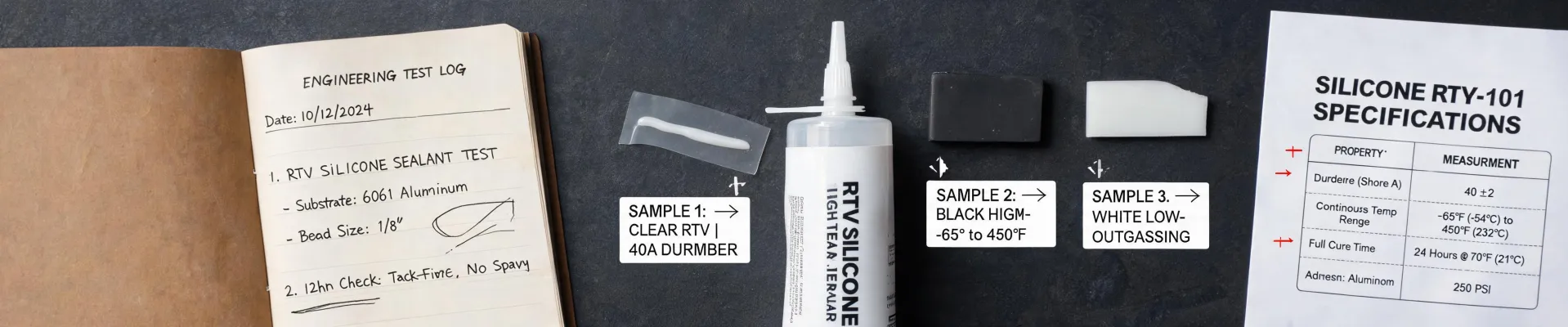
Every Momentive product has a data sheet. But the real test is your application. I've had a silicone gasket sealer that looked perfect on paper, but when we applied it on a slightly oily surface (our shop floor reality), it didn't bond properly.
My process:
- Request a 1-quart sample (most distributors offer this—if they don't, red flag)
- Test on the actual substrate you'll use (not a clean lab sample)
- Apply, cure, and test under the temperature and humidity of your shop
- Document the results: bond strength, cure time, smell (yes, odor matters in closed spaces)
In 2023, we tested 3 Momentive RTV silicone samples for a gasket application. Sample A was $14.20/unit. Sample B was $16.80. Sample A failed at 120°C in our test. We saved nothing—it cost us $450 in rework. Sample B was the right choice all along.
Step 5: Verify the Vendor's Credentials — Not Just Their Price List
You can buy Momentive products from a lot of places. But authorized distributors maintain proper storage (silicones have shelf life; improper storage degrades them), offer the full product range (not just fast movers), and can provide certs of analysis.
What I check:
- Are they a listed Momentive distributor? Momentive's website has a distributor locator.
- Do they offer same-day shipping for in-stock items? If not, check lead times carefully.
- Can they provide a certificate of conformance? For regulated industries, this is non-negotiable.
- What's the return policy on defective material? If they say 'no returns,' that's a warning.
The upside of an authorized distributor is traceability and quality. The risk of a discount reseller is 10-20% savings—but potentially mismatched stock or expired product. Is the savings worth the risk? I usually say 'no' for critical sealants. For non-critical applications? Maybe. But I sleep better knowing the origin.
3 Things That'll Burn You (That I Learned the Hard Way)
1. 'Momentive' doesn't mean identical. The brand makes hundreds of formulations. 'Momentive RTV silicone' isn't a thing—it's a category. Make sure you're buying the exact product number.
2. Lead times stretch. As of Q1 2025, some specialty Momentive silicone foams have 6-8 week lead times. Verify before you budget a 2-week project.
3. The 'cheaper' distributor often isn't. The vendor with the lowest unit price often has higher shipping, less support, and tighter payment terms. Run the total cost.
This was accurate as of Q1 2025. The materials market changes fast—silicone prices fluctuate with raw material costs—so verify current pricing and lead times before you commit.