At 8:47 on a Tuesday night, I typed “is rubber thermoset or thermoplastic?” into Google. That’s not a normal search when you’ve been buying custom rubber parts for 12 years. It’s the kind of search you do after a $3,196 order fails in front of an engineer who trusted your spec.
Let me explain how I got there. I’m not a polymer chemist. I spec custom seals, gaskets, and foam components for industrial equipment. Most days, my job is translating an application into a material that survives it. One time, I got the material class wrong. Not because I didn’t care, but because I let a few words—“PVC foam, equivalent”—do a job that only a real spec could do.
It Looked Right. That Was the First Mistake
The job was 850 die-cut silicone foam pads for a control enclosure. A transformer on one side ran around 80°C, so heat resistance was part of the application whether I wrote it down or not. Thermoset silicone foam handles that temperature with room to spare. The lower quote came back with a note: “PVC foam proposed as equivalent.”
I knew I should check the datasheet. I knew the thermal environment wasn’t negotiable. But the project was late, the supplier had worked with us for years, and I thought: what are the odds they’d propose something that fails? The odds caught up with me.
The pads arrived looking right: same closed-cell appearance, same peel-and-stick backing, same hand-squeeze softness. They didn’t look wrong when they went in. They looked wrong after the heat rise test, when one pad slumped out of its channel. Another one stuck to the enclosure wall like melted cheese. PVC foam softened under heat and sustained load. Thermoset silicone foam would not have done that.
To be fair, PVC foam has its place. It’s cheap, light, easy to machine, and widely used in signage, packaging, and low-temperature sealing. It just isn’t a silicone replacement when the material has to hold shape at 80°C.
The Deeper Issue: “Rubber” Is a Behavior, Not a Chemistry
That failure made me look up why I had been so careless. The root cause wasn’t the supplier. It was the word “rubber” on my own mental spec.
Rubber-like materials can be divided into two broad groups.
A thermoplastic softens when heated and hardens when cooled. Its polymer chains are not cross-linked. Heat it enough and it can flow, melt, and be reprocessed. PVC, including much PVC foam, is typically thermoplastic.
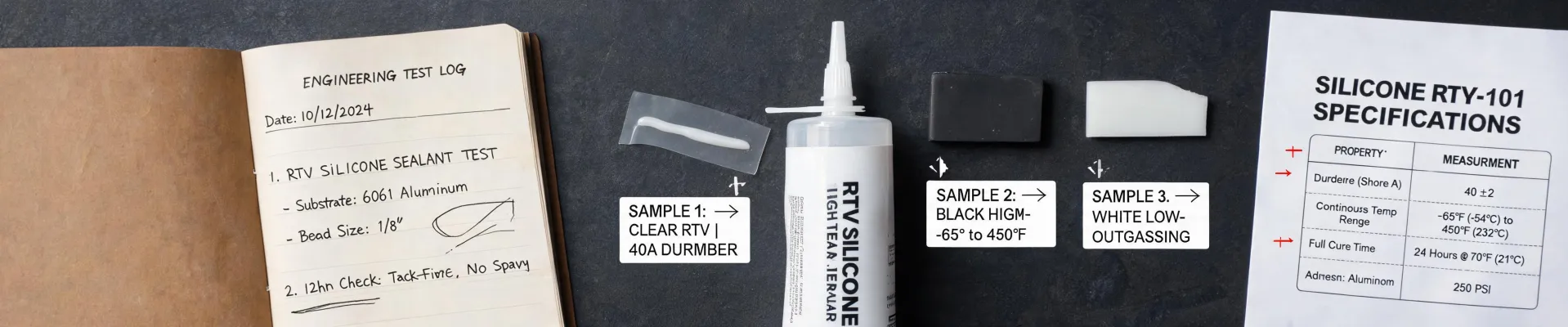
A thermoset forms chemical cross-links during curing. After those links are created, the material can’t melt or be re-formed. Heat it too far and it will degrade or char before it flows like a thermoplastic. Thermoset silicone is in this category. Momentive RTV silicone, which cures at room temperature, is one widely used example: mix it, let it vulcanize, and you’ve got a cross-linked rubber that won’t go back to a liquid.
If you’ve ever cooked with a silicone whisk, you already have a mental model. The silicone coating on that whisk is thermoset. It’s cross-linked during manufacturing, which is why it can sit in hot water, snap back, and still keep its shape. A thermoplastic version would soften and deform under the same conditions.
So “is rubber thermoset or thermoplastic?” doesn’t have a single answer. It has two answers, depending on the rubber. That’s why a drawing that says “rubber” or “foam” and no more is a trap.
“Momentive GE Silicone” Is a Clue, Not a Full Spec
The second part of my education had to do with the names I used on drawings. Many old material specs in our archive list “Momentive GE silicone” in the approved column. I used to treat that phrase as if it named one material. It doesn’t.
GE Silicones developed a broad technology base, and Momentive carried that portfolio forward. When you see “Momentive GE silicone,” it tells you the material is part of a specific product heritage. That’s useful background. But it doesn’t tell you the grade, hardness, cure chemistry, form, or temperature rating.
Same with “Momentive RTV silicone.” RTV means room-temperature vulcanizing, which is a processing detail. The phrase implies the material cures without an oven, but it doesn’t tell you whether the product is one-part or two-part, moisture-cure or addition-cure, solid rubber, pourable liquid, or foam.
I skipped that homework when I approved the PVC foam substitution. I had a brand-family word in my head, “silicone,” and a vague category word, “foam,” and I mistook both for engineering. The result was an 850-piece lesson in why brand names and category names are not specifications.
What That Mistake Actually Cost
The 850 pads cost $3,196.00. They were scrapped as a lot; once the spec violation was on the table, no one could promise the rest of the batch wasn’t affected.
The hard cost didn’t stop there. Replacement material added roughly $780, plus two days of labor to remove sticky foam residue from the prototype enclosure. The project slipped about a week. And I had to answer the question, “Who approved that substitution?” with the truth: I did, without verification.
I still kick myself about it, because one question would have stopped the whole failure. If I had asked, “Is this material thermoset or thermoplastic?” the PVC foam proposal would have collapsed immediately.
The industry has changed too. What was best practice in 2020—specify by brand, trust the same supplier, don’t worry about product changes—doesn’t work as well in 2025. Material lines get discontinued, supply chains shift, and substitutions arrive with a convincing note that says “equivalent.” My old habit-based process hadn’t changed. Now it has.
A Simple Pre-Order Check
I still order silicone and foam parts. I still make errors. But I’ve cut down the expensive ones with three rules:
- Write the material class on every request. If the part must survive heat or hold a shape, I state either thermoset or thermoplastic and the maximum continuous service temperature.
- Don’t accept “equivalent” without a data sheet. If the drawing says silicone foam, a quote that says PVC foam is not a small substitution. It’s a different material class.
- When a drawing says “Momentive GE silicone” or “Momentive RTV silicone,” treat it as the start of the search, not the end. Look for the exact product name, cure system, and thermal rating before signing.
The question “is rubber thermoset or thermoplastic?” sounds like a textbook review question. I promise you, it’s a purchasing question. Ask it before you approve the quote, not after the foam melts.