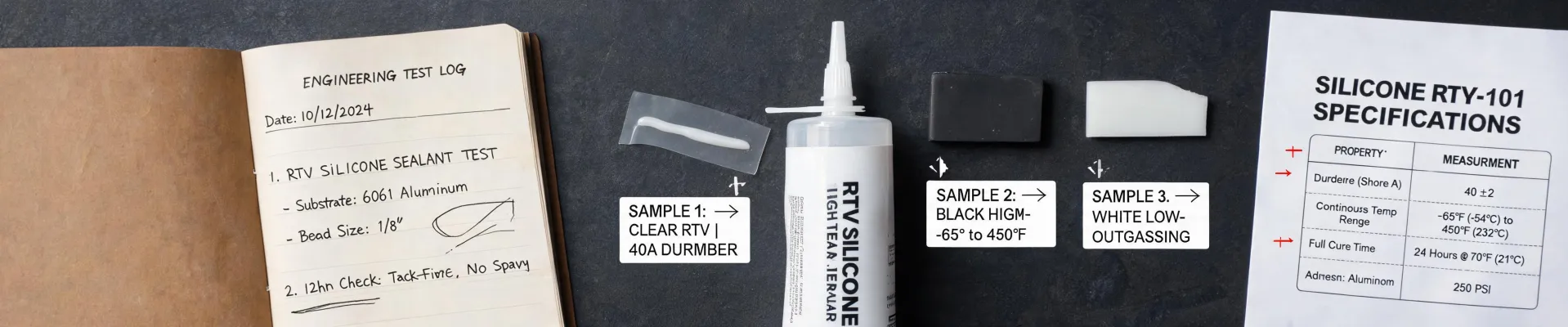
Here's the short answer to the question that probably brought you here: thermoplastic elastomer (TPE) is not silicone. And cross-linked PE foam isn't either. If you're comparing quotes across these three materials for the same part, you're not comparing like for like—you're weighing a component that costs more today and keeps working for a decade against one that saves money on paper and fails in 18 months.
I've watched this exact mistake play out more times than I can count. Over the past six years, I've managed the materials procurement budget for a mid-sized industrial equipment manufacturer—roughly $180,000 in cumulative polymer and rubber spending, tracked across every order and invoice. I've compared quotes from eight or more suppliers, built total cost of ownership models for five material families, and learned the hard way that the cheapest upfront quote is frequently the most expensive option over time.
From the outside, a low unit price looks like a procurement win. The reality is that the purchase order is only the beginning—installation, maintenance, replacement and warranty costs typically dwarf the initial price difference.
What Each Material Actually Is
Let's clear up the terminology first, because half the confusion I see starts there.
Silicone—including the materials produced by Momentive, whose product line traces back to GE Silicones and what many engineers still call "Momentive GE silicone"—is a synthetic polymer built on a silicon-oxygen backbone. That structure is why it survives extreme temperatures, shrugs off UV and ozone, and keeps its flexibility for years. It's thermoset: once cured, it can't be melted down and re-molded.
Thermoplastic elastomers are a different family. TPEs blend plastic and rubber characteristics. They soften and flow when heated, which makes them fast and cheap to process—injection molding instead of compression molding, for example. But that same thermoplastic behavior means they deform and lose performance at temperatures where silicone doesn't flinch. You might also see the term "thermoplastic rubber" or "rubber thermoplastic"—that's essentially the same family marketed under a different label.
Cross-linked PE foam is a closed-cell polyethylene foam that's been cross-linked through irradiation or chemical processing. It works well for cushioning, gasketing in low-stress assemblies, and vibration damping. It is not a substitute for silicone rubber in demanding sealing or high-temperature jobs.
Here's something vendors won't tell you: all three materials can feel surprisingly similar when you squeeze a sample in your palm. The differences only show up in the data—temperature ratings, compression set, chemical resistance, long-term aging. Not in the initial tactile impression.
What This Costs in the Real World
In Q2 2024, we sourced a dust seal for an outdoor enclosure. Vendor A quoted a TPE seal at $0.14 per unit. Vendor B quoted a liquid silicone rubber part at $0.31 per unit. Our annual volume made that a $4,800 gap. The project engineer wanted the TPE, and honestly, I didn't push back as hard as I should have.
Twelve months later, the numbers told the real story. The TPE seals had hardened noticeably after a year of outdoor exposure in a climate that the spec sheet said they could handle. Compression set—the ability to spring back after being squeezed—had degraded to the point that one in six seals leaked during our water ingress test. The silicone seals showed no measurable change.
The "cheap" option resulted in a $1,200 rework charge when quality failed. Don't hold me to this, but I'd estimate the field labor added another $400 to $600 on top of that. We switched to the silicone supplier before the next production run. The net result: a potential $4,800 saving turned into a $1,200 loss. That's a swing of $6,000 on a single part.
What most people don't realize is that this pattern repeats across industries. I've compared notes with procurement peers in automotive, medical devices, and consumer goods, and the story is consistent: low-cost materials are only low-cost until they fail in the field.
How to Calculate the True Total Cost
I'm a numbers person by job description, so let me give you the framework I actually use. I do not recommend skipping the first step, even though it feels like guesswork.
Step one: define your failure conditions. What's the worst thing that happens if this part fails? A leak, a short, a safety hazard. Put a dollar figure on it. In our case, a field failure cost roughly $90 per unit in labor and shipping, on top of the part itself.
Step two: estimate the realistic lifespan. Not the theoretical number on a datasheet. The realistic lifespan in your actual environment—temperature swings, UV exposure, chemical contact, mechanical stress. If your application runs hot, TPE ages dramatically faster. That's not speculation; it's how the polymer chemistry works.
Step three: model the three-year cost. Silicone parts last longer, so they're replaced less often. TPE parts are cheaper to buy but may need replacement—and the labor that goes with it—within a year or two. Cross-linked PE foam is cheaper still, but it's rarely the right answer for sealing at all.
When I audited our 2023 spending, I found that 14% of our budget overruns traced back to materials that were cheaper per unit but failed before their expected lifespan. We now require a three-year cost projection for any polymer part quoted with a lifespan under five years. That policy cut material-related rework costs by roughly 40%.
The Question You Actually Asked: Is TPE Silicone?
Let me answer this directly, because it keeps showing up in sourcing conversations.
No. TPE is a broad category of copolymers that behave like rubber but process like plastic. A small subset is silicone-based—thermoplastic silicone vulcanizates, sometimes called TPSiV—but the majority are styrenic (TPS), polyolefinic (TPO), or polyurethane-based (TPU). If a salesperson tells you "our TPE is basically silicone," treat that as a red flag. A material that melts and re-flows when heated cannot match the thermal resistance and long-term compression set of a thermoset silicone.
That said, TPE has legitimate strengths. It's recyclable, processes faster, and it's genuinely cheaper in low-stress applications. I use TPE parts for cable strain reliefs, dust covers, and interior components that never face extreme conditions. It's a good material when it's specified for the right application.
When Silicone Justifies the Premium
From a cost perspective, silicone earns its higher price when any of these are true:
- Sustained temperatures above 150°C or below -40°C
- Long-term sealing or gasketing where compression set matters
- Outdoor UV and ozone exposure
- Contact with chemicals, oils, or cleaning agents
- A high cost of failure
Momentive silicones have stayed on our approved supplier list because their liquid silicone rubber and high-consistency rubber grades have performed consistently across years and batches. In 2022, during a supply shortage, I sourced an alternative from a secondary vendor at an 18% discount. The lot-to-lot variance was visible within the first month: I had to adjust process parameters three times in a single quarter. The material was somewhat less consistent across batches, and the supplier's own technical team told me something I won't forget:
"Your specifications are tighter than what most customers need."
That was a warning I chose to ignore for the price differential. Part of me still wonders if I overreacted. On one hand, the cheaper material was clearly less consistent. On the other, the rework and downtime that quarter cost us roughly $700, which was less than the 18% discount we captured. I have mixed feelings about that episode, but the longer-term data convinced me: consistency is worth paying for when your production line depends on it.
When the Cheap Option Is the Right Option
I'm not arguing that everyone should buy silicone for everything. That would be lazy procurement, and it would waste money.
Cross-linked PE foam and TPE are the correct choice in plenty of scenarios:
- Interior applications with operating temperatures under 80°C
- Parts that are designed to be replaced or have short service lives
- Cushioning and vibration isolation where sealing isn't critical
- Prototyping, before the design is validated
- Projects where recyclability is a regulatory or corporate requirement
The key is choosing deliberately, with full awareness of what you're giving up. The spec sheet describes a best case. Your application might be closer to the worst case, and the cost distribution reflects that.
Questions to Ask Before You Commit
Here's the thing: the first quote is almost never the final price in an ongoing supplier relationship. There's usually room to negotiate once you've demonstrated you're a reliable buyer. Regardless of which material you're considering, ask these four questions:
- What's the compression set at 25% deflection after 100 hours? If they can't answer from memory, this material is not their core competency.
- What's the typical lot-to-lot hardness variation? A serious supplier will quote ±5 Shore A or tighter. Anything wider means process headaches on your end.
- Can you test the material against my specific chemical or environment? A good supplier runs the test. A mediocre one reads from a generic compatibility chart.
- What's the actual lead time? Whatever they quote, add two weeks for the first order.
Where This Advice Has Limits
I want to be honest about the boundaries here.
Everything above assumes you're choosing a material for a part that needs to seal, insulate, or survive years of service. If you're picking a material for a disposable consumer product with a one-year life, TPE is likely the right answer—and cross-linked PE foam might be too.
I'm also not a chemist. I'm a procurement professional with six years of order data and a strong preference for documented results. If you're working on safety-critical applications—medical devices, aerospace, high-voltage insulation—you should be working alongside your supplier's engineering team, not making material decisions from a procurement blog post.
Finally, prices move. The numbers I've cited come from our actual purchase orders in 2024, and I verified them against publicly listed prices as of January 2025. But silicone pricing in particular has been volatile recently, driven by raw material costs. Get current quotes from at least three suppliers before you commit.
At the end of the day, the right question isn't "which material is cheapest per unit?" It's "which material costs the least over the life of the product, including failures, rework, and warranty exposure?" That's the question I wish more sourcing decisions started with. Take this from someone who's paid the difference more than once.