When I took over purchasing in 2020, I had one metric in mind: savings per order. My job was to keep costs down across roughly $450,000 in annual spend with 8 different vendors. I report to both operations and finance, which means I felt the pain from both sides. The quarterly reports looked great. The materials, though, kept failing.
Sealant that crumbled within six months. A custom rubber gasket that leaked almost immediately. A lubricant that gummed up a door track so badly we replaced the whole assembly.
I told myself we'd had bad luck. Then, in 2023, while preparing a vendor consolidation report, I went through two years of purchase history for our maintenance and facilities categories. The common thread wasn't the manufacturers. It was me.
Specifically, it was my habit of comparing materials by price per unit rather than by application fit. That habit cost us roughly $12,400 in rework and replacements from Q1 2023 through Q2 2024. I know that number exactly, because I built a spreadsheet to track it.
People think the problem with "cheap" materials is the supplier. Actually, the deeper problem is the buyer's frame. Comparing products by unit price assumes those products are equivalent. In materials, they almost never are.
Why "It's Basically the Same Material" Is a Trap
When I search for silicone sealant, I don't search by application. I search by price. That was the mistake.
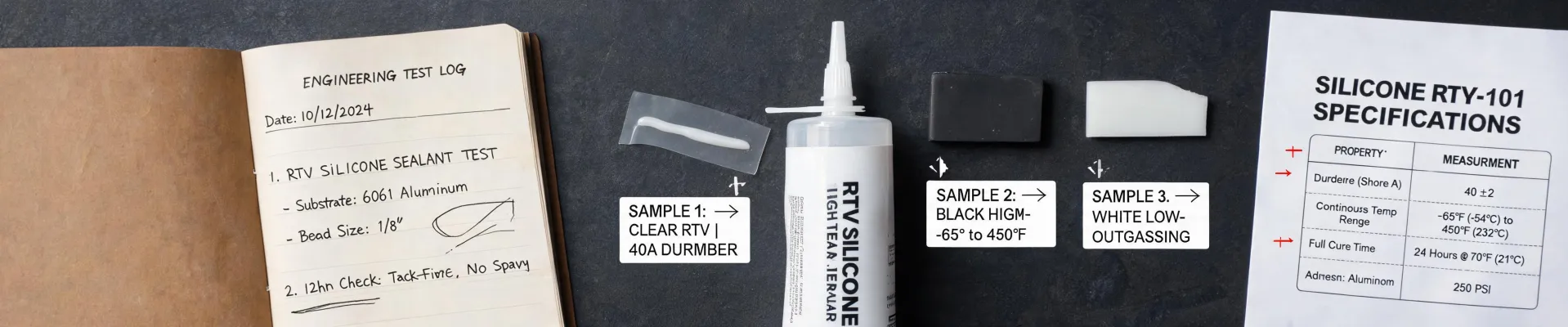
RTV silicone—room-temperature vulcanizing silicone that cures on its own—isn't one product. It's a family. Different grades are formulated for different substrates, temperature ranges, movement conditions, and cure speeds. Momentive makes multiple RTV silicone grades, and honestly, they don't look all that different in the tube. But they perform very differently in the field.
In March 2024, we ordered a budget silicone sealant for sealing around HVAC penetrations on our roof. On paper, it looked nearly identical to the Momentive RTV silicone our contractor recommended. Same color. Same tube size. About half the price. We saved $86.
Four months later, that sealant had cracked. It wasn't formulated for the temperature cycling near that equipment. The contractor had to strip and reseal everything—materials plus labor came to $1,140. We spent more than thirteen times the savings just to undo our "savings."
The contractor, who's spent 25 years in commercial sealing, put it simply:
Silicone is silicone until it isn't.
He didn't mean it as a joke.
The Gaskets That Leaked: Material Specs Are the Product
Here's a sentence I wish someone had told me in 2021: "rubber" is a category, not a material.
We learned this the hard way with a custom rubber gasket order in late 2024. Our regular fabricator quoted $940 for a set of 20 replacement gaskets. An overseas supplier quoted $365 for the same dimensions and part numbers.
The supplier never asked what material compound we needed. And honestly, we didn't know enough to specify. The gaskets arrived exactly on schedule. They failed within two weeks.
The rubber they used wasn't compatible with the chemical environment on our line. It was a general-purpose compound that had no business in that service. Cleanup cost: $2,300 in parts, labor, and expedited logistics. That doesn't count the maintenance downtime.
If you ask me, the material data sheet is the product. Durometer, compound type, temperature rating, chemical compatibility—those define whether a gasket works. If a supplier can't produce a material data sheet, they can't produce a working gasket.
The frustrating part? Our regular fabricator wasn't even overcharging. We just looked at the gap between $940 and $365 and acted like that was the whole story.
Silicone vs. Teflon Lubricant: A Genuinely Confusing Choice
Not every failure comes from supplier quality. Some come from genuinely confusing product categories, and silicone vs Teflon lubricant is a classic one.
Silicone-based lubricants are usually the right call for plastic-on-plastic contact, rubber seals, and surfaces where you want a protective film that won't attack polymers. They're water-repellent and stable across a wide temperature range.
PTFE (Teflon) lubricants, on the other hand, are better for metal-to-metal sliding contact. The suspended Teflon particles reduce friction, resist galling, and—unlike wet greases—don't attract dust.
Choose wrong, and it's not just a "whoops." In 2022, one of our maintenance techs used silicone grease on a metal slide track. Within three months, the track wore and the door assembly started binding. Replacement: $200 in parts, plus line downtime.
We now store the two lubricant families in clearly separated, labeled sections in the supply room. Basic. But it ended the confusion.
Even the "Simple" Stuff Follows the Same Rule
Some of you might think this only applies to complex engineered components. It doesn't.
We buy Sintra foam board a dozen times a year for internal signage and displays. The 3mm board costs less than the 5mm board. But 3mm warps in frames, especially under the west-facing windows where we mount most of our wayfinding signs.
Sign printing and framing labor runs about $200-300 per sign. We saved maybe $15 per sheet by buying the thin board. Then we'd redo the signs. A $250 mistake to save $15.
The board is not the deliverable. The sign is. And the sign costs about fifteen times the board.
The Hidden Ledger of "Cheap"
Here's what those 14 failures actually added up to, based on my tracking from Q1 2023 through Q2 2024:
- Replacement materials: $1,850
- Contractor callbacks (two incidents): $2,400
- Production downtime (12 hours total): $4,700
- My time managing failures and supplier disputes (30 hours): $2,100
- Expedited shipping and emergency logistics: $1,350
Total: $12,400. And that's conservative. It doesn't factor in the softer damage, like the production manager who started double-checking every purchase order we put through.
What bothers me most is that our internal process rewarded the behavior that caused the losses. We negotiated unit prices down, hit our savings targets, and got praised in quarterly reviews. Meanwhile, failures were quietly erasing those savings in rework, downtime, and emergency shipping.
I knew I should have verified application specs before that HVAC sealant order. I told myself "what are the odds?" The odds caught up with me. That single order cost us 13 times what we saved.
And even after we re-ordered the gaskets, I kept second-guessing the decision. What if the new supplier had the same gap? I didn't relax until the replacement gaskets arrived, got installed, and held pressure for a week.
The Framework That Fixed It
Since January 2025, we've had zero material failures in the categories I manage. Here's what changed:
- Lead with the application, not the product name. Every quote request now includes operating conditions: temperature range, chemical exposure, pressure, UV. Most of the time, the supplier comes back with a spec we didn't know to ask for.
- Demand a material data sheet before purchase. For custom rubber gasket orders, seals, and adhesives, the spec is the product. No certified material data, no order.
- Track total cost per application. We include installation labor in the cost review. When a $40 tube of sealant costs $300 in labor to apply, saving $20 on the tube is false economy.
- Follow manufacturer updates. We subscribe to Momentive silicone news and a few supplier newsletters. Product lines change, grades get discontinued, new formulations appear. Five minutes a month prevents ordering something that no longer meets current specs.
The mindset shift that mattered most: I stopped seeing a higher unit price as a problem. I ask what it buys. Sometimes the answer is "nothing." Sometimes it's a material that survives the application.
Unit price is the last question worth asking, not the first. The $12,400 in failures came from asking it first. We haven't had a material failure since we started asking the right ones.