-
Be honest about what you're not
-
Thermoplastic elastomer vs rubber: not a contest
-
EVA foam material: the right call for the wrong part
-
Why Momentive RTV silicone was the answer
-
The first mistake: batch verification
-
The tacky surface mystery
-
When a label almost caused a bigger problem
-
Delivery and what I'd actually do differently
At 2:30 on a Tuesday in March 2024, I was packing up to leave the shop when the phone rang. A customer needed 200 rubber knives delivered by Thursday. Not the weapon kind—the production tool kind. Their packaging line uses soft rubber-bladed knives to separate sticky bakery sheets, and if the line went down at a trade show demo on Friday, their client would trigger a $50,000 penalty clause.
The customer's regular supplier had called at noon and said they couldn't make it. Normal lead time was ten days. We had 48 hours. I started doing the only useful thing I could think of: triage.
Be honest about what you're not
Here's what our company actually is: we make custom gaskets and seals. We are not a custom knife manufacturer. When I told the customer that, I thought they might hang up. But I also said we weren't going to guess. I said we'd check our material options and call back in one hour.
That honesty is the only reason we got the job. A generalist who says "sure, we can do anything" would have burned their deadline and their penalty clause. We said, "this isn't our normal lane, but here's how we'd probably build it." That was enough.
Thermoplastic elastomer vs rubber: not a contest
By 3:30 I was at a table with our lead fabricator and three material samples. The customer's rubber knife had to flex, survive 180°F steam washdowns, and not shred after a few hundred cycles. It also had to be castable at room temperature because we didn't have an injection molding press free.
The classic debate is thermoplastic elastomer vs rubber. TPE is usually easier to injection mold and can be recycled, but it's not always good in hot, greasy, washdown environments. Rubber—especially silicone—handles heat and chemicals better, but it's harder to prototype unless you use a room-temperature cure.
People think one is objectively better. That's not true. The question is always: what is the part touching, and how long do you have to make it? In this case, the answer was heat, caustic wash, 48 hours, and no press. That pushed us straight to silicone rubber.
EVA foam material: the right call for the wrong part
We also considered EVA foam material for the handle. It's light, cheap, easy to shape, and great for a quick prototype. But the handle would see the same steam washdown as the blade. EVA foam degrades in hot water and caustic solutions. We didn't use it for the knife. We ended up using EVA foam material for the inserts in the shipping boxes, which were one-time use anyway.
That might sound obvious now, but it wasn't obvious at 4:00 PM while the clock was ticking. The temptation to pick the easiest-to-machine material is strong. Specialists know that "easy to make" and "right for the job" are different. The material you love for one part can be the worst choice for the part next to it.
Why Momentive RTV silicone was the answer
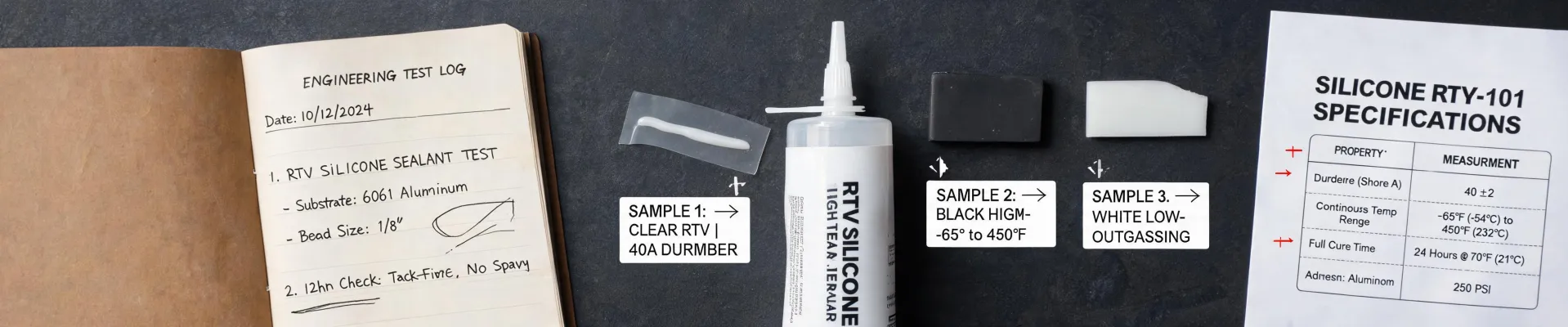
We needed a flexible rubber part with a Shore A hardness around 50, made in hours, without an injection mold. That's a job for Momentive RTV silicone—a room-temperature vulcanizing rubber.
I've used Momentive RTV silicone for prototype gaskets before, so I trusted the cure behavior. The Momentive Silicones technical data sheet confirmed what I remembered: mix, degas, pour, let it cure. No oven, no press, no 40-ton mold.
People still think "silicone rubber" means caulk or baking mats. That thinking comes from an era when RTV silicones were mostly sold in caulking tubes. Today, Momentive RTV silicone is a precision material with predictable durometers. It was the only way to make 200 blades and still hit a Thursday deadline.
The first mistake: batch verification
Here's where the whole thing almost fell apart. I ordered what I thought was the same product we use for gaskets, without checking the batch certificate. The first pour set up too soft—more like a kitchen sponge than a rubber knife. I knew I should have verified the durometer on the batch certificate, but I thought, "we've been using this for months. What are the odds?"
Well, that was the one time it mattered. We scrapped about 30 parts and lost two hours.
We didn't have a formal material verification checklist for quick-turn orders. After that afternoon, I made one. Three lines: product number on the technical datasheet, batch certificate, and a bench test before pouring all 200. If we'd had that checklist, we would have caught it before the first pour.
I still remember the cost, though I might be misremembering the exact numbers. The trial silicone kit was around $300. The rush fee for the mold shop was $600—or maybe $550, I'd have to check. Base order was around $1,800. We lost about $300 in wasted material. It was a painful $300, but it taught us more than a smooth order would have.
The tacky surface mystery
Once the durometer was right, we hit a second issue. The first two parts came out of the mold with tacky surfaces. Honestly, I'm not sure why. My best guess is the spray release agent didn't fully dry before we poured the silicone. I've never fully understood release agent interactions with RTV cure. If someone has insight, I'd love to hear it.
We cleaned the mold, dried it for 20 minutes, and the next part cured clean. I don't know with certainty which factor fixed it. Sometimes in a rush, you solve the problem without fully understanding it. You note it for next time.
When a label almost caused a bigger problem
There was also a marketing landmine. The customer asked if we could print "recyclable" on the packaging. This is where a vendor needs to hold the line. Per FTC Green Guides (ftc.gov), environmental claims like "recyclable" must be substantiated, and the product should be recyclable in areas where at least 60% of consumers have access. We were in no position to verify that in a rush order, so we told the customer: don't make that claim yet.
I did not want to promise something we couldn't prove. That distinction—the difference between what a generalist will print and what a specialist will verify—is the same reason the customer came back to us.
Delivery and what I'd actually do differently
We finished the 200 blades at 6:00 AM Thursday. The customer picked them up at 8:00, drove to the trade show, and the demo went off. At 11:00 PM Wednesday, I was convinced the second batch was too soft. It wasn't—I was comparing it to a gasket sample from a different project. I want to say the final durometer was 50 Shore A, but don't quote me on that. The bench test passed, and the customer's own test was better than my memory.
People think rush orders cost more because they're harder. The reality is they cost more because they're unpredictable and they disrupt planned workflows. We pushed back three smaller jobs to make that delivery. That's what the rush fee was really paying for—unpredictability, not difficulty.
If I had to boil it down to a few lessons:
- Specialists beat generalists in a crisis, but a specialist who can't say "I don't know" is useless.
- Momentive RTV silicone is a lifesaver for prototype quantities, but you still have to verify the batch—not the part number from last month.
- Thermoplastic elastomer vs rubber isn't a debate. It's a compatibility and timeline question.
- EVA foam material is useful, but only for parts that won't be steamed or caustic-washed.
- A vendor who tells you a claim isn't ready may be worth more than the vendor who prints it.
"We can do anything" is usually the first sign of a problem. The vendor who says "this isn't our strength—here's who does it better" earns trust. I'd rather work with a specialist who knows their limits than a generalist who overpromises. In a 48-hour emergency, that boundary isn't a limitation. It's the whole reason we delivered.