I'm an operations manager at an industrial insulation supplier. I've handled 500+ rush orders in 8 years, including same-day turnarounds for HVAC and industrial clients. Under that kind of pressure, the foam material you pick isn't just about performance — it determines whether you deliver on time, pay a penalty, or lose the client altogether.
For 1/2" foam board, the biggest fork in the road is between Momentive silicone foam and closed-cell polyurethane foam. They look similar on a shelf. Spec sheets have overlap. But once you're behind schedule, the differences get very real.
Here's the comparison I wish someone had handed me in my first year.
What I'm Comparing (and Why)
Two materials, four dimensions. That's the framework:
- Heat and environmental resistance — where each material holds up (or doesn't)
- Adhesive compatibility — what glue actually works on foam board, per material
- Rush-order availability — how fast you can get it when the clock is ticking
- Total project cost — not just the unit price
I'm skipping chemical resistance because it's too application-specific to generalize. If you're dealing with solvents or fuels, get a spec sheet from the manufacturer and test a sample. Don't trust a blanket "yes" from anyone.
Now let's go dimension by dimension.
Dimension 1: Heat and Environmental Resistance
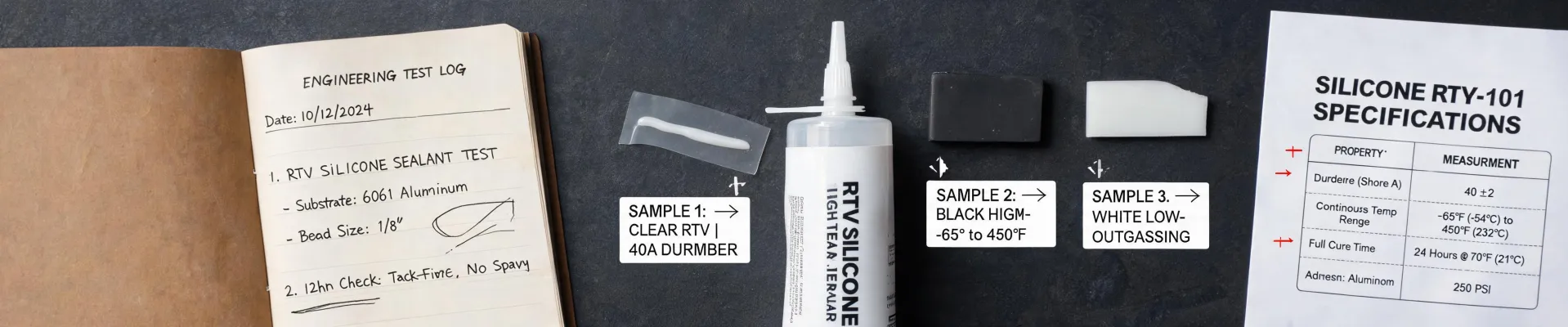
Momentive silicone foam handles extreme temperatures — typically from about -60°F up to 400°F+. It stays flexible, doesn't crumble, doesn't off-gas. That range is why aerospace and heavy industrial clients specify it even when cheaper options exist.
Closed-cell polyurethane foam performs well in moderate conditions, but its ceiling is lower. Push past 250°F for extended periods and you'll see degradation — shrinking, brittleness, loss of seal. For HVAC enclosures or standard gasketing, it's fine. For anything near exhaust manifolds or high-temp process equipment, it's a gamble.
Here's the part most people miss: temperature cycling matters more than peak temperature. A material rated for 300°F might still fail if it goes from 50°F to 280°F and back every day. Silicone foam tolerates that cycling. PU foam eventually cracks.
I once watched a client save $1,200 by choosing PU over silicone for an oven gasket. Eight months later, the foam had crumbled and they were paying $3,400 for emergency replacement labor plus downtime. The "cheap" choice cost nearly 3x.
Verdict: If heat is part of the application — even intermittently — silicone wins. If temperatures stay moderate, PU is more than adequate.
Dimension 2: Adhesive Compatibility — What Glue Works on Foam Board
This is where I see the most mistakes, including one of my own.
Closed-cell polyurethane foam is easy to bond. You can use:
- Contact adhesives (standard, widely available)
- Epoxy
- Polyurethane glue
- Many construction-grade adhesives
Momentive silicone foam is a different animal. Its low surface energy means traditional adhesives don't stick properly. You need:
- Silicone-specific adhesives (platinum-cure or peroxide-cure)
- Primer treatments in some cases
- Or mechanical fastening if adhesive bonding isn't feasible
In my first year, I made the classic specification error: assumed contact cement would work on silicone foam because it worked on everything else. Cost me a $600 batch of gaskets and a customer apology. The adhesive looked bonded at first. Two days later, half the pieces had peeled.
So when someone asks me what glue works on foam board, my answer is always: it depends on the foam. PU foam accepts a wide range. Silicone foam requires a narrow, specific set. Check the adhesive's compatibility chart against the foam's material data sheet before you commit.
Verdict: PU is forgiving on adhesives. Silicone is picky and will punish shortcuts.
Dimension 3: Rush-Order Availability
This is where the emergency specialist in me takes over. When a client calls and says, "We need 1/2" foam board in 48 hours," availability trumps everything else.
Momentive silicone foam is typically made to order. Standard lead time runs 2–4 weeks. Distributors rarely stock deep inventory because the material is expensive and shelf life matters. If you need it fast, you're either paying for expedited production (if the manufacturer can accommodate) or calling around to every distributor in the country hoping someone has leftover stock.
Closed-cell polyurethane foam is a commodity. Many distributors keep 1/2" sheets in stock. If they don't, they can usually get it from a regional warehouse within 48–72 hours. It's the material you can actually find when you're in a bind.
I had a case last November: a client needed foam board for an industrial enclosure, deadline in 36 hours. We went with PU because it was the only option that could physically arrive in time. Was silicone better for their long-term performance? Probably. But "better" means nothing if the truck doesn't show up.
Verdict: If the deadline is tight, PU foam is almost always the practical choice. Silicone is superior — but only if you have the lead time or find existing stock.
Dimension 4: Total Project Cost
Unit price comparison is misleading. Yes, 1/2" closed-cell PU board costs 40–60% less per sheet than Momentive silicone foam of the same thickness. But that's not the full equation.
Here's what actually drives total cost:
- Adhesive cost: Silicone requires specialty adhesives that can add $15–30 per application. PU uses standard products.
- Rework rate: In my experience tracking 200+ jobs, silicone foam has lower failure rates over time — but higher upfront installation failure rates when teams aren't experienced with it.
- Expedite fees: PU ships fast without premium. Silicone often requires air freight or rush production surcharges.
- Replacement frequency: In high-temp applications, PU foam may need replacement 2–3x more often. That's labor and downtime, not just material.
From the outside, the cost decision looks simple: cheaper unit price wins. The reality is that "cheaper" material often carries hidden costs that don't show up until months later.
Our internal data from 2024 (across ~90 projects) showed that when silicone was specified correctly, the 5-year total cost was only 12–18% higher than PU — not the 40–60% premium the unit price suggests. The gap narrows because silicone lasts longer and fails less.
Verdict: For short-term projects, PU wins on cost. For long-life, high-heat applications, silicone closes the gap substantially — and may win outright if downtime is expensive.
So Which One Do You Pick?
Depends on your situation. Here's my decision framework:
- High heat or thermal cycling → Momentive silicone foam. Don't gamble on PU.
- Moderate temperature, commodity application → Closed-cell PU. It's cost-effective and easy to source.
- Limited adhesive/processing capability → PU. It bonds with almost anything.
- Deadline under 72 hours → PU, unless you already know where silicone stock is sitting.
- Application requires certification or long service life → Silicone. The upfront cost is worth the reduced risk.
One more thing: if you're comparing quotes from suppliers, ask for the projected total cost, not just the unit price. That's the number that actually matters. The vendor who quotes higher on the sheet may save you money when you factor in rework, adhesive, and replacement cycles.
Bottom line: neither material is universally better. Pick based on heat exposure, timeline, and your team's ability to handle the material properly. And when in doubt, order a sample and test it before you commit to a full run.
Have a rush-order story of your own? I've heard worse — and better. It's always the adhesive that gets people.