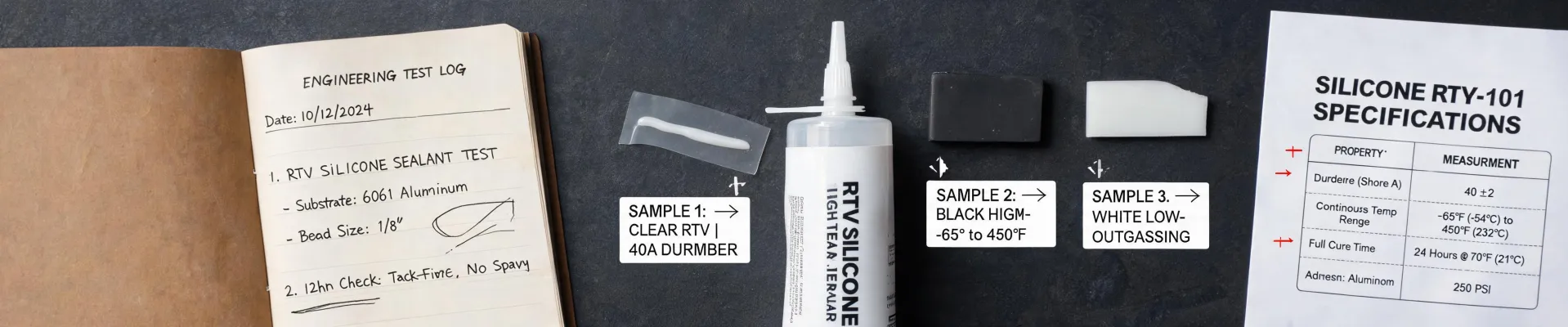
As operations coordinator at a specialty materials distributor, I've handled 200+ rush orders in 8 years, including same-day turnarounds for trade show exhibitors and industrial plants. When a client calls at 9 a.m. needing a 3mm foam board by Friday, you don't have time to "figure it out as you go."
This is the exact checklist I walk through for every rush order. Six steps, in order. If you're sourcing silicone foam, hard rubber strips, or similar materials under a tight deadline, this is for you. Skipping steps is where the pain starts.
Step 1: Write down the spec before you call anyone
First step. Seriously. In my first year, I made the classic specification error: assumed "standard" meant the same thing to every vendor. Cost me a $600 redo. A client approved a preliminary spec, my vendor filled the gaps by making assumptions, and we got the wrong density foam. Not entirely their fault. I should have been explicit.
Before you make that first call or send that first email, write down:
- Thickness. Exact numbers. "3mm foam board" means 3mm, not "about 3mm" or "one-eighth inch."
- Density and hardness. For silicone foam, typically kg/m³ or lb/ft³. For rubber strips, a Shore A value.
- Temperature range. What will the material actually see in service?
- Flame and fire ratings. Some applications require specific certifications.
- Compression set. If it needs to spring back after being compressed, you need this number.
- Dimensions and unit quantities.
When I'm triaging a rush order, this list is the difference between one helpful phone call and four days of "actually, let me check..." If you can't specify it, nobody can source it.
Step 2: Start at the official source
If you need genuine Momentive silicone foam, go to the momentive official website first. I know it's tempting to type "silicone foam for sale" into a search engine and pick the cheapest listing. Don't. I've caught two separate cases where distributors had outdated specs on their third-party pages. In both cases, the spec sheet was from an older product version.
The official site has the current datasheets and actual application guidance. If you're not sure whether the material will work in your temperature range or compression setup, that's where you'll get the real numbers.
This gets into material science territory, which isn't my expertise. What I can tell you from a procurement perspective is: a vendor who can't tell you the exact source of their "compatible" product probably won't have the documentation you need if something fails. Per FTC guidelines (ftc.gov), performance claims must be truthful and substantiated. If a distributor claims their product "will perform just like Momentive," ask for the test data. If they can't produce it, that's a red flag.
Step 3: Check what's actually in stock
This is where most rush-order projects break down—in my experience, 8 out of 10. A vendor can have the perfect spec listed on their website. Doesn't matter if the warehouse doesn't have it. That 3mm foam board at the killer price? Minimum order: 50 sheets. Lead time: three weeks. By then, your deadline is long gone.
The first question I ask every vendor is "What's in stock right now?" Not "Can you provide this?" If they pause for more than a second, it's a special order. Move on or confirm the real lead time.
After three failed rush orders with discount vendors in one year, we implemented a policy: "in stock or it doesn't exist." Painful lesson, but it stuck. We now ask for stock quantities before we ask for prices. A vendor with 20 sheets of 3mm foam board on the shelf is worth more than one with a great price and an empty warehouse.
Step 4: Compare total cost, not unit price
Here's the part nobody likes hearing: the cheapest quote is rarely the cheapest. The $500 quote for hard rubber strip turned into $800 after shipping, setup, and expediting fees. The $650 all-inclusive quote was actually cheaper. I now calculate TCO before comparing vendor quotes. You should too.
Here's what goes into the total:
- Unit price. The number on the invoice.
- Shipping and handling. Ask for it explicitly or you'll get a surprise.
- Minimum order penalties. If you need half of the MOQ, you might end up buying twice the material.
- Setup or tooling fees. Some suppliers charge for cutting to size.
- Time cost. How many days until it's at your dock? A "cheap" supplier with a 4-week lead time is expensive if you need it next week.
- Risk cost. What happens if it's the wrong spec? Returns aren't free.
If you ask me, ignoring the last two is why people end up paying double in the long run. Time is part of the price. A $1,000 quote that arrives in 2 days beats a $700 quote that takes 3 weeks when you have a deadline. The $700 one isn't just slower—it's risky.
Step 5: Cut foam board the right way
If you're cutting the material yourself, the technique matters. Whether you're working with PVC foam board or silicone foam, the principles are the same. Learning how to cut pvc foam board properly is one of those underrated skills that saves hours of frustration.
My preferred approach:
- New blade. Every time. A dull blade crushes instead of cuts, leaving a rough edge.
- Score and snap for thin material. For 3mm and under, score with a sharp utility knife and snap over a straight edge. Clean break.
- One continuous pass. Don't saw back and forth—you'll get a ragged edge and the blade will skid.
- Clamp a straight edge down. The straight edge determines the quality of the cut.
- Smooth the edge afterward. Medium-grit sandpaper or a deburring tool cleans up the last bit.
For hard rubber strip, score the backside and bend. Trying to cut through the full thickness in one pass gives you a rough edge and a headache. Not ideal, but workable: you can sand it smooth after. If you're cutting a large quantity, consider having the supplier pre-cut. It adds a little to the cost, but remember the TCO conversation from Step 4.
Step 6: Build in delivery buffer
Even with everything up to this point, delivery is where risk lives. "Estimated" arrival dates are exactly what they say, and in my experience, they're optimistic more often than not.
In March 2024, a client called 36 hours before a trade show needing gaskets cut from silicone foam. Normal turnaround: five days. We found a vendor with stock, paid $400 extra in freight to get the material overnight, and delivered the gaskets with eight hours to spare. The client's alternative was missing the trade show entirely.
Also check whether the shipping method is guaranteed. Standard parcel delivery has no guarantee. Express freight usually does. According to USPS pricing effective January 2025, First-Class Mail letters cost $0.73. A 3mm foam board sheet? That's freight, not a letter. When comparing shipping costs, don't assume the cheap parcel rate applies to your material. Ask for freight quotes with guaranteed delivery dates.
What the failures taught me
After all these years, the failures taught me more than the wins. The biggest mistakes I see:
- "Same specifications" doesn't mean the same result. I once specified "3mm foam board" to three vendors and got three different products. One was 2.5mm, one was 3.2mm, and the third was something else entirely. Send your spec in writing and make them confirm in writing.
- Choosing by unit price alone. The TCO conversation is uncomfortable, but skipping it is how you end up paying $800 for a $500 quote.
- No buffer. If the deadline is Friday, aim for Wednesday. I'd rather explain why a project is done early than why it missed a deadline.
- Not verifying stock. All the good pricing in the world doesn't help if the material isn't on a shelf.
Final thoughts
A few honest caveats. This approach worked for us, but our situation is a mid-size distributor with predictable ordering patterns. If you're dealing with one-off purchases, seasonal demand spikes, or international logistics, there are probably factors I'm not aware of.
I'm also not a materials engineer—for technical spec questions, talk to the supplier directly or reference the datasheets on the momentive official website.
Bottom line: check stock before you check prices, write the spec before you call anyone, and make the vendor prove delivery will hit your deadline. You'll thank me later.