Thursday, 3:47 PM. My phone lit up with an alert from the Momentive customer portal—the same one I log into through the momentive login page at least a dozen times a week. A client I'd worked with for years had just submitted an urgent request. A water treatment tank was going offline in 36 hours for scheduled maintenance, and they needed replacements before the shutdown window closed.
The list looked straightforward at first:
- Momentive silicone sealant for flange gaskets
- Closed-cell hydrophobic polyurethane foam for floatation panels
- Nitrile butadiene rubber (NBR) gaskets for chemical feed lines
All of it needed to arrive on-site before the maintenance window ended. That's not "wow, impressive" tight. That's "skip lunch, double-check everything, and hope the freight gods smile on you" tight.
I've coordinated hundreds of rush orders in my time. By now, the rhythm is second nature: confirm specs, check stock, arrange freight, track like a hawk. But this particular order nearly went sideways—not because of freight or supplier problems, but because of an assumption I'd made a hundred times before without ever getting burned by it.
The Assumption That Almost Cost Me the Order
When I first looked at the material specification, my eyes skimmed over "polyurethane foam" and I mentally filed it under "similar enough." The client's original equipment had used polyethylene foam. PE foam. It's cheap, light, closed-cell, and everywhere. And polyurethane foam—PU foam—well, it's also a foam. It's a bit denser. It costs more. But at a glance, both are soft, flexible, closed-cell materials. How different could they really be?
Pretty different, as it turned out.
The price comparison made the PE substitution even more tempting. The local supplier quoted PE foam at 20% less than the spec'd PU foam, with same-day delivery. My internal cost spreadsheet said "go with PE, save money, meet the deadline."
But my gut said something was off. Why would a client's engineering team spec polyurethane foam if standard PE foam worked fine? In my experience, engineers don't add expensive materials to a spec for no reason. So I paused the order and logged into the Momentive portal to pull the technical datasheet for the exact PU foam formulation listed.
That's when I saw the word I'd missed in my first skim: hydrophobic.
Not just "polyurethane foam." Hydrophobic polyurethane foam. That's a specific formulation designed to resist water absorption over time. And in a wastewater treatment environment, where floatation panels sit submerged in chemical-laden water day after day, that difference isn't academic. It's the difference between a flotation system that stays buoyant for years and one that slowly waterlogs and sinks.
Polyethylene Foam vs Polyurethane Foam: The Real World Difference
Let me break this down the way I wish someone had for me years ago.
Polyethylene foam is closed-cell, which means water doesn't easily penetrate the surface. That sounds like it should be waterproof. And for short-term exposure, it is. But here's the catch: PE foam's closed cells can deform permanently under sustained compression. Once those cells collapse, water finds pathways into the structure. Over years of service—not days, but years—PE foam in submerged or high-humidity applications gradually gains weight. Buoyancy drops. Performance degrades.
Polyurethane foam can be formulated entirely differently. The hydrophobic version is engineered with a cellular structure that repels water at a chemical level, not just a physical one. It's not about being "denser" or "softer." It's about the material's relationship with water over time. And in a flotation panel that either floats or fails, that relationship is everything.
To be fair, PE foam has its place. It's excellent for packaging, vibration dampening, and temporary cushioning. It's cheap and versatile. But "excellent for packaging" and "adequate for a decade of chemical water exposure" are different conversations. The engineer who wrote that spec knew it. I almost didn't.
The lesson: identical specifications on paper doesn't mean identical behavior in the field. "Same dimensions" isn't the same as "same performance characteristics."
The NBR Gasket: A Secondary Near-Miss
While I was sorting out the foam issue, another part of the order quietly slipped into my blind spot: nitrile butadiene rubber gaskets, or NBR.
NBR is the standard choice for oil-resistant seals and gaskets. It's tough, it handles petroleum products well, and it's widely stocked. But here's what I didn't check: the chemical feed lines in this particular system weren't carrying oil. They were carrying a dilute acid solution.
The issue surfaced when my supplier mentioned NBR was on backorder—10 days out. Wait, I said. We don't have 10 days. The 36-hour clock was already ticking.
Suddenly I had a decision: substitute EPDM rubber (available immediately) or find another supplier with NBR in stock. My first instinct was to do whatever it took to find the NBR—because the spec said NBR, and I didn't want to be the guy who deviated from spec without approval.
But then I remembered something from a previous project: the original equipment drawings for this client's system had specified Viton for those same connections. Viton. Not NBR. The system had been changed to NBR at some point during a cost-optimization pass. And that cost-optimization had never been validated against the actual chemical exposure.
I called the client's engineer. "What's in those feed lines?"
"Dilute sulfuric acid," he said. "Low pressure. Why?"
I explained the NBR backorder. He thought for a second and said, "EPDM's fine for that. Viton's overkill. Go with EPDM."
So we did. Did it save the day? Yes. But it also exposed the trap I'd almost fallen into: treating a spec sheet as a magic document to be followed without remembering to understand why it was written that way.
The Pricing Ledger: When Transparency Saves the Sale
Here's where the money comes in—because a rush order is never just about materials. It's about speed, and speed has a price.
I contacted three suppliers for the Momentive silicone sealant and the hydrophobic PU foam. The results were telling.
The first vendor quoted $1,050 for materials. When I asked about shipping, he said, "We'll calculate that later." That's not a price. That's a starting point for negotiation.
A second source quoted $980—but then added a separate "rush handling fee" that only appeared after I asked why the total was 40% higher than expected.
Then there was the third one. He said: "Materials are $1,200. Expedited freight to your site is $340. If you need it before 10 AM tomorrow, that's $260 additional for a dedicated truck. Total: $1,540. Here's the invoice. No surprises."
Look, $1,540 is more than $980. On paper, the second vendor looks cheaper. But by the time I added the $275 freight, the $90 expedite fee, and the $40 "environmental surcharge" that materialized on his final invoice, the actual landed cost was nearly identical to the third vendor—plus a lot more stress and a slower confirmation.
I've learned to ask "what's not included" before asking "what's the price." The vendor who lists all fees upfront—even when the total looks higher—is the one who actually costs less in the end. That's not idealistic. That's the result of a decade of getting burned by "competitive" quotes that grew like a snowball on every follow-up call.
In this case, the third vendor's transparency earned more than the order. It earned the right to be the first call I make next time something breaks at 4 PM on a Friday.
Also worth noting: the signed purchase order had to get back to the supplier before they'd release the freight. I sent it overnight via USPS Priority Mail Express—according to USPS pricing effective January 2025, the flat-rate envelope costs $28.75. Painful for one sheet of paper. But a $50,000 penalty clause makes $28.75 look like a rounding error.
The 2:15 AM Delivery
The truck arrived at 2:15 AM—less than 36 hours after the client's first notification. We unloaded five drums of Momentive silicone sealant, four crates of hydrophobic PU foam panels, and a box of EPDM gaskets. The driver didn't have to help, but he did. That's what happens when you treat freight carriers like people instead of vendors.
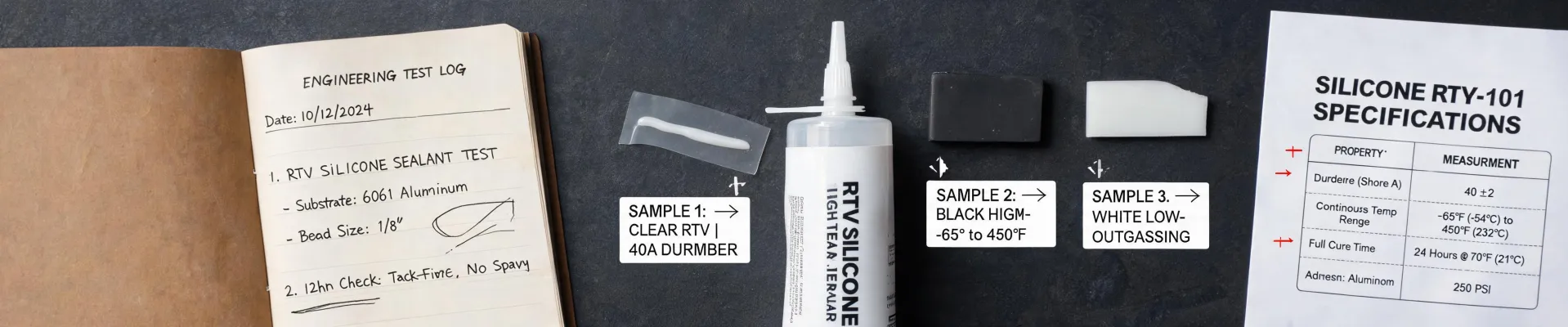
By 6 AM, the maintenance crew was on-site. They applied the Momentive silicone sealant to the flange gaskets with steady hands and close attention to the datasheet's application notes—cleaning the surface, working the sealant into the joint, smoothing it to the exact bead shape recommended. This particular sealant survives temperature swings from -60°F to 400°F and shrugs off UV exposure. In an outdoor water treatment setting that cycles between steam cleaning and cold chemical feed, that's not flexibility. That's necessity.
The PU foam panels floated exactly where they should. The EPDM gaskets sealed their connections without a single leak. The tank went back online at 4 PM, right on schedule.
There's something deeply satisfying about watching a well-coordinated rush order land. After the stress, the ambiguity, and the financial math, seeing it work is the payoff. And the client noticed. "You got it here," the plant manager said. "I wasn't sure you would."
What I'd Tell Someone Facing the Same Emergency
If you take away only one thing from this, make it this: materials that look similar are not necessarily interchangeable. PE foam looks a lot like PU foam. NBR looks a lot like EPDM. But "looks like" is a terrible engineering standard.
Three specific lessons:
- Read the full spec, including the adjectives. "Hydrophobic" was the difference between a successful order and a slow-motion failure. The same logic applies to "food-grade," "UV-stabilized," "flame-retardant"—every qualifier exists because someone learned the hard way that the base material wasn't good enough.
- Don't substitute materials based on price or availability without checking the application. And if you do need to substitute, call the engineer who wrote the spec. Not the purchasing manager. The engineer. They know why the material was chosen in the first place.
- Demand all-in pricing. A quote that excludes freight, handling, and expedite fees isn't a quote—it's an invitation to surprise invoices. Transparent pricing, even when it's higher upfront, is a signal that the supplier has nothing to hide. That's the kind of supplier you want in an emergency.
One final thought: I'm not 100% sure the PE foam would have failed immediately. Maybe it would have been fine for a while. But "maybe" is not a risk you take when the alternative is a $50,000 unplanned shutdown and a client who loses trust in you. The real cost difference isn't between PE and PU foam. It's between a spec sheet followed literally and a spec sheet followed intelligently.
So next time you see "or equivalent" at the end of a material spec—take it as a challenge, not a shortcut. Do the research. Ask the question. And remember: in my experience, "equivalent" rarely is.
Material performance claims mentioned in this post are based on manufacturer-published technical datasheets and personal experience. Always verify specifications against the manufacturer's current documentation for your specific application.