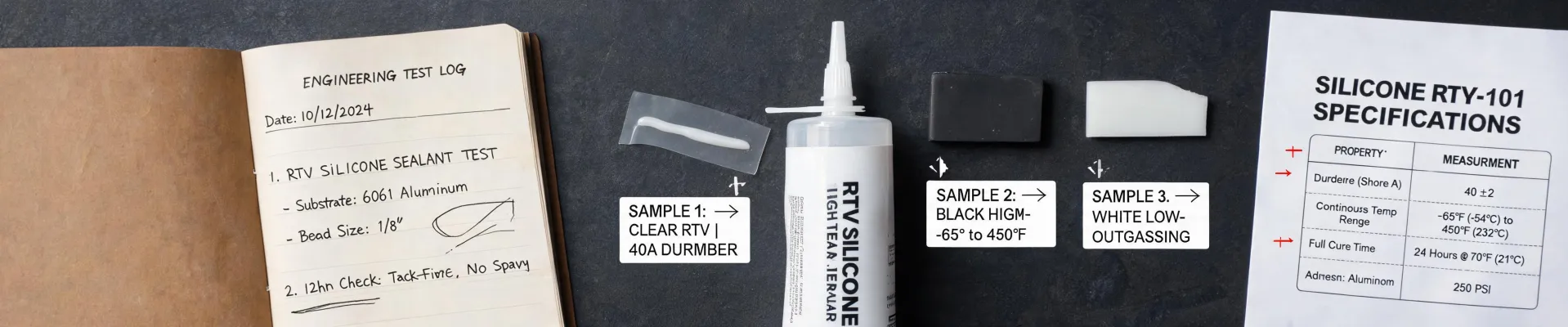
I've spent the last four years reviewing material batches before they reach customers—200+ unique specs a year, give or take. And I keep arriving at the same conclusion: most material failures are not production failures. They're specification failures.
Somewhere in the supply chain, someone decided that one material was "basically the same" as another. They saved a few percentage points on the purchase order. Then I get to see the consequences at the inspection bench.
This article is my argument for why material selection is a specification discipline, not a shopping decision. And why a proper spec will do more for your bottom line than any vendor discount.
Everything I'd Read About Elastomer Selection Was Incomplete
Everything I'd read about comparing elastomers said to focus on the obvious physical properties: hardness, tensile strength, service temperature range. Those matter. But in practice, the failures I trace back in our quality audits are rarely about the numbers on a datasheet. They're about long-term behavior—compression set, chemical resistance, aging characteristics. The stuff that never makes it into a one-page comparison chart.
Take the difference between silicone rubber and natural gum rubber. To a casual buyer, they're both "rubber." But gum rubber is a natural material with batch-to-batch variability. It's perfectly fine for floor mats, trim strips, simple vibration dampers—applications where tight tolerances and long-term stability aren't critical. Put it into continuous heat, ozone, or certain oils, though, and it degrades. Silicone rubber holds up.
That's why the price gap exists. Not because someone is trying to overcharge you. Because the performance envelope is genuinely wider.
Specification Is an Efficiency Strategy
This might surprise you from someone in quality control, but I'm a strong believer in process efficiency. I think it's a competitive advantage. And I'd argue that a clear specification is one of the most underrated efficiency tools in manufacturing.
When you define material requirements precisely, everything downstream speeds up:
- Supplier qualification drops from weeks to days.
- Incoming inspection runs on clear pass/fail criteria.
- Field failures—and the expensive rework they cause—almost disappear.
We implemented a standardized material verification protocol in 2022. Our average vendor qualification time went from 5 days to 2 days. A 60% efficiency gain from one document.
(The procurement team was skeptical, not gonna lie. They thought more paperwork would slow things down. In practice, it did the opposite.)
Some procurement folks treat specifications as a constraint that blocks speed. I've found the opposite: the more specific the spec, the faster the sourcing. It's counterintuitive until you live it.
Efficiency also means using the right sources. If you're sourcing silicone materials, the Momentive official homepage has engineering data on their elastomer line—hardness, tensile strength, compression set, thermal limits. Reading that data takes ten minutes. But honestly? Most buyers who specify "momentive silicones" by name never open a single datasheet. They stop at the brand name. That's not efficient. That's just naming a product family.
The $22,000 "Basically the Same"
Here's what that costs in practice. In Q4 2023, our engineering spec called for a specific silicone foam density from one of our approved suppliers—Momentive, in that case. We had tested and qualified that exact material. We knew how it performed.
The vendor didn't tell us they planned a substitution. They just ordered a polyurethane foam injection part instead. It was 11% cheaper and, in their words, "basically the same."
It wasn't.
The dimensions matched. Density looked acceptable. But compression recovery—how well the material returns to shape after being compressed—missed our requirement by a wide margin. Our field test caught it before it reached customers. The redo cost us $22,000 and delayed the launch by three weeks.
A lesson learned the hard way.
Even Foam Board Deserves a Spec
Now the unglamorous example. Foam board is probably the least glamorous material we handle. But it proves the point just as well.
People search "what to cut foam board with" and expect a one-line answer. The real answer depends on what the board is made of. Polystyrene foam cuts cleanly with a utility knife or a hot wire. Polyurethane foam—especially injection-molded polyurethane—behaves differently. Use the wrong blade and you get edge tearing, dust, and dimensional drift. I've rejected parts for edge-tolerance issues that traced back to a dull blade on a cutting table.
The cutting spec even affects shipping. USPS defines a large envelope (flat) as up to 12" x 15", with a maximum thickness of 0.75 inches (source: USPS Business Mail 101, pe.usps.com). A half-inch foam board sample cut square to those dimensions can ship as a flat—$1.50 base rate for the first ounce as of January 2025 (usps.com)—instead of a parcel. But that only works if the cut is clean and square. Six degrees of wedge, and your $1.50 flat becomes a $10+ parcel.
(A quality inspector's version of being penny-wise, pound-foolish. I've shipped enough misshapen samples to know.)
Claims Aren't Proof
Another pattern I see: unsubstantiated material claims. A vendor once put "recyclable" in big letters on their polyurethane foam packaging. Per the FTC's Green Guides—16 CFR Part 260, published at ftc.gov—a product can only be called recyclable if recycling facilities exist for a substantial majority of consumers, defined as at least 60%, in the areas where the product is sold.
Our region didn't have that infrastructure. We asked for substantiation. They couldn't provide it. We made them change the packaging.
Was the foam itself bad? Maybe not. But if a supplier can't back up a marketing claim with evidence, it makes you wonder what else they aren't substantiating.
To Be Fair, Budgets Exist
Granted, budgets are real. The 11% cheaper alternative looks great on a procurement slide. And sometimes a lower-cost material is genuinely fit for purpose. I'm not saying every application needs a premium silicone grade. That would be ridiculous.
What I'm saying is that fitness for purpose must be demonstrated, not assumed. And I've been guilty of assuming myself. I once skipped a final verification step on a material we'd sourced for years, thinking, "what are the odds the supplier changed something?" They had changed their raw material source. The batch looked fine at the dock. It failed at the customer's site. The rework cost roughly five times what the verification would have cost.
I get why people choose the cheaper option. Money saved is money available elsewhere. But the hidden costs add up: expedited shipping (which, honestly, always feels like paying for someone else's mistake), rushed rework, missed deadlines. It's the definition of being penny-wise and pound-foolish.
The Verdict
I'll repeat what I said at the start, because I believe it strongly: material selection is a specification discipline, not a shopping decision.
The companies that pass our quality audits most consistently are not the ones with the lowest purchase orders. They're the ones with the clearest, most verifiable specifications. They keep an approved materials list. They don't accept "basically the same" without documentation. They apply the same rigor to a foam board sample as they do to a structural component.
That discipline is efficiency. It shortens qualification cycles, reduces rework, and protects launch dates. It also protects your reputation, because you ship what you promised—not something "basically the same."
Next time a vendor suggests a cheaper material swap, ask them to prove it meets your spec. In writing. Good suppliers will usually welcome that question. The others will give you a story.
Price references (USPS rates) are effective January 2025; verify current rates at usps.com. Regulatory guidance on environmental claims summarized from 16 CFR Part 260; consult ftc.gov for the full text.