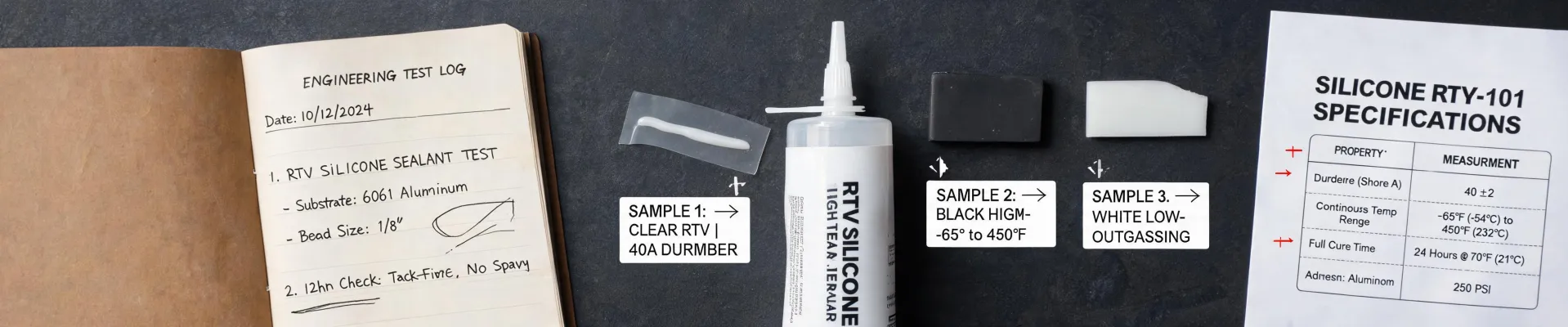
If you're buying silicone sealants or rubber compounds on unit price alone, you're probably losing money. I know because I spent 11 years making that mistake—and I've got 13 documented failures and roughly $210,000 in wasted budget to prove it. The $2,800 I saved on a cheaper polymer eventually cost us $16,000 in scrap, tooling, and downtime. That single number is why our procurement team now compares total cost of ownership (TCO) before we look at any per-pound quote—not just for Momentive silicone sealants, but for every material that touches our production line.
I still handle material orders, but these days I also maintain our team's pre-purchase checklist. To understand why I'm so stubborn about TCO, you need to see the mistakes that created it.
The First Mistake: Assuming “Silicone” Means “Same”
In my first year (2017), I ordered what I thought was a “direct equivalent” silicone sealant for an 800-piece production run. It looked right on the spec sheet—viscosity, cure time, even the color. But the adhesion test was terrible. Every single unit had bond failure when we hit the heat-aging step. The quote was about $450 cheaper than the Momentive product we'd used before, but the redo cost $890 and added a one-week delay. I saved $450 and spent $1,340. That's when I first learned that “similar” is not “same.”
I also learned something simpler: I had assumed “silicone sealant” meant “same performance.” It doesn't. Per FTC guidelines (ftc.gov), claims like “equivalent to” or “food-safe” need evidence to back them up. We stopped accepting marketing sheets as proof and started asking for test data.
The $4.20/lb TPR That Wasn't Cheaper
The bigger lesson came in 2022. We needed material for a weather-resistant gasket in an outdoor enclosure. The incumbent was Momentive silicone rubber—overkill for some people, but right for a part that had to survive heat, cold, and UV. A cheaper supplier offered a thermoplastic rubber (TPR) compound at $4.20/lb, versus $5.85 for our existing silicone. If you're asking “what is thermoplastic rubber made of,” the short answer is: usually a blend of plastic and rubber—often styrenic block copolymers (like SBS or SEBS) plus process oils and fillers. That blend makes TPR generally cheaper to compound and easy to injection-mold. In the right application, it's a perfectly good material. But it is not a drop-in replacement for silicone under every condition. Our TPR sample seemed fine in the office; in the heat chamber, it softened. At -30°C, it went brittle. We started production, and the failure rate climbed to about 25%.
Do the math on a 1,700-pound order: the silicone quote came to $9,945, and the TPR quote came to $7,140. Saving: roughly $2,800. Then we paid for two failed production batches, replaced defective parts, shut down the line, and rushed freight for the correct silicone. The total extra cost was more like $16,000 (ugh). To be fair, TPR wasn't a bad material. It was the wrong material for that specific spec. The mistake wasn't asking for a cheaper option; it was making a decision on unit price without checking the total cost of the decision.
Tooling, Foam Molds, and Other Hidden Lines
A few months later, I made a variation of the same error. In September 2022, we needed a short-run mold for a silicone part. To save on tooling, I chose a polyurethane foam mold instead of a machined aluminum or cured silicone mold. Polyurethane foam is cheap and easy to shape—but it's porous and dimensionally unstable for repetitive molding. The mold absorbed moisture, the cavities swelled, and we got an entire batch out of spec. The order was worth $3,200, and we lost three days waiting for a replacement mold.
The ironic part is that a simple call to momentive support would have answered the tooling question in minutes. I skipped it because I was in “save money fast” mode. Now supplier support is a line item in our TCO: if a supplier can't answer basic process questions quickly, that delay has a cost too.
Why Low Unit Price Feels So Persuasive
Why did I keep falling for the same trap? Because a lower number on the quote is pretty persuasive, especially when someone above you is asking why costs went up (more often than not). It's the same reason a 72 DPI screenshot looks fine on a computer screen but awful on a 24×36 inch foam board. Context decides what's cheap.
That's also how foam board prints entered our checklist. I once approved a display board using that 72 DPI screenshot, thinking I'd save 30 minutes of file prep. The print came back blurry and pixelated. Industry standard for commercial print is 300 DPI at final size; I know that now, and it's on our pre-check list. The board wasted $450. Small mistake, same pattern.
The Checklist That Caught 47 Errors
After the third rejection in Q1 2024, I built our pre-check list. It covers polymer type, temperature limits, chemical exposure, tooling compatibility, test data, and total landed cost. In the last 18 months, that list has caught 47 potential errors—wrong durometers, incompatible primers, uncertified test data, and one mislabeled batch that would have failed a customer audit. The list has started to feel like a safety net, not a formality.
The TCO framework we use is simple, and you can copy it:
- Unit price and minimum order quantity
- Tooling, priming, or setup fees
- Scrap rate and rework labor
- Downtime and line-change costs
- Shipping speed your project actually needs
- Technical support response time
That last item matters more than people think. A 20-minute call with someone who knows their material can save you from a $4,000 primer failure. And a supplier who doesn't answer email for two days is already costing you money, whether or not it shows on the invoice.
So Should You Always Buy Momentive Silicone?
Not necessarily. Silicone isn't the right answer for every application, and Momentive products aren't always the best fit. If one of my team members buys a cheaper material that works the first time, I'm fine with it. The point is to compare the full job, not the sticker price. In many of our jobs, Momentive silicone sealants and rubber win because they're consistent and well-documented—not because they're cheap.
I can only speak to my context: mid-sized manufacturing with a mix of prototyping and production. If you're doing one-off craft parts or non-critical decorative pieces, the calculus might be completely different. That's okay. The checklist still helps.
“The cheapest material is the one that works the first time. The most expensive is the one that doesn't.”
So build your own pre-check list. Include material type, environment, test data, tooling compatibility, support access, and the cost of failure. Compare the full job, not the unit price. And if you're under pressure to go cheap, that's exactly when you should slow down. It took me 13 mistakes and about $210,000 to learn that. Hopefully this article saves you one of each.