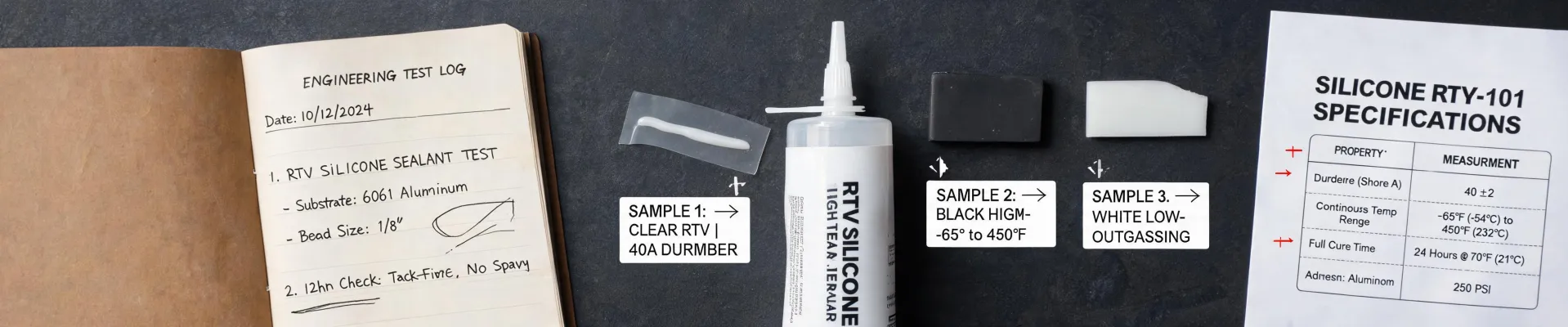
I'll say it plainly: most silicone material procurement failures are avoidable. They're not caused by defective manufacturing or dishonest suppliers. They're caused by buyers who skip a ten-minute spec check and pay for it with weeks of rework.
I'm an office administrator for a mid-sized manufacturing company. I manage all material purchasing—roughly $480K annually across 30+ vendors. That includes silicone sealants, silicone rubber sheets, and silicone foam for production needs. I report to both operations and finance, so I see the full cost of every ordering mistake.
Five minutes of verification beats five days of correction. Every time. That's not a slogan. It's a cost statement.
The Order That Cost $7,000
In 2023, I ordered silicone rubber sheets for a customer's gasket fabrication project. The purchase order said "silicone rubber, 1/8\" thickness." Straightforward, right? I didn't check the Shore A hardness.
The material arrived. Production cut it. The gaskets were installed—and failed compression testing within a week.
The rubber was too soft. The application required 60 Shore A; what we received was closer to 40. Nobody specified hardness, so the supplier—a reputable one—shipped their standard soft-grade sheet. That's on me, not them.
Here's what that mistake cost:
- Original material scrapped: $1,240
- Expedited replacement, including overnight freight: $1,860
- Production downtime across two shifts: roughly $4,000 in absorbed labor
- Account manager time and customer goodwill: impossible to quantify, but it set back our renewal discussions
Total: over $7,000. The spec check that would've prevented it? Ten minutes, maybe less. I updated my ordering template the same day. It now has twenty lines for any silicone product, and hardness is line one.
The Problem With "Silicone" as a Word
Part of the issue is that "silicone" sounds like one thing but is actually a material family. Silicone sealants, silicone rubber, and silicone foam have very different property profiles. Even within one product type, grade selection changes everything.
Momentive is a good example. Their product line includes room-temperature vulcanizing sealants, high-consistency rubber, liquid silicone rubber, and silicone foam—and that's not even the full catalog. A neutral-cure sealant behaves completely differently from an acetoxy-cure one. Temperature resistance varies from -60°C to 200°C+ depending on grade. Tensile strength, elongation, compression set—each specification alters the application envelope.
There's also an outdated assumption floating around that because Momentive's technology traces back to GE Silicones, all their products are interchangeable with legacy grades. You'll still see "Momentive GE Silicone" in old documentation and reorder spreadsheets. But the product catalog has evolved significantly since the spinoff. Some legacy part numbers map to newer generations with different formulations. That's why I make a point of following Momentive silicone news and technical bulletins—I can't assume last year's grade is still this year's best fit.
You can't order "Momentive silicone" and expect it to work across every use case. You need to know what you're actually buying. A distributor's technical team is helpful—I've leaned on them more than once—but they can only work with the requirements you provide.
The Same Lesson Shows Up Everywhere
Here's the part that surprised me most: the principle isn't unique to silicone. It applies to nearly every material purchase I've made. That realization turned this from a personal rule into a departmental standard.
For example, we've evaluated nitrile rubber manufacturing options for oil-resistant components. Nitrile grades vary by acrylonitrile content, which directly changes the balance between oil resistance and low-temperature flexibility. On paper, "nitrile rubber" looked like a single product. In practice, picking the wrong grade would've created the same kind of failure we experienced with the silicone sheets.
Similarly, a colleague recently asked, "where can I get foam board?" for a packaging project. DuPont foam board is a legitimate option—lightweight and easy to fabricate. But foam board density and R-value change thermal performance dramatically. If you don't specify those parameters, you're at the mercy of whatever the supplier defaults to. And in a business setting, "at the mercy of defaults" is a risk I'm no longer willing to take.
The pattern is consistent: a one-line description is not a specification. Whether it's Momentive silicone, nitrile rubber, or foam board, you need to know the operating conditions and required properties before you order.
Objections, Addressed
I know what some of you are thinking, because I was there not long ago. Let me address the two most common pushbacks.
"Shouldn't the supplier help with this?"
Yes, good suppliers do ask clarifying questions. The Momentive-authorized distributors I've worked with have walked through application requirements with me and caught ambiguous specs before. But they work with the information I give them. If I send a PO that says "silicone rubber, 1/8 inch" without a hardness requirement, they have no way to know what my end-use demands. The supplier is not inside my production environment.
"This is overkill for routine orders."
I understand the impulse. But the $7,000 mistake I described above WAS a routine order. It was a reorder of a material we'd purchased before. The only thing that changed was the application, and neither I nor the supplier caught it until the gaskets failed.
A spec checklist takes less than ten minutes per application. Store it on a shared drive, and you do the work once, then reuse it every time. The template I created in 2023 has processed every silicone reorder since without a single mismatch. That's not overhead; that's leverage.
Honestly, I'm not sure why upfront verification isn't the industry standard already. My best guess is that most buyers juggle so many orders that the "it worked last time" shortcut feels rational. But last time is not a specification. Last time is an anecdote with good timing.
One more caveat: my experience is based on roughly 200 material orders over five years, mostly with domestic suppliers. If you're sourcing internationally or in a heavily regulated sector like aerospace or medical devices, you might need an even more rigorous process. But I'd bet the core principle holds.
Prevention Is Buying Power
Here's why I'm stubborn about this.
In 2024, I led our vendor consolidation project and reduced suppliers from 12 to 8. Procurement costs dropped 9%. But the bigger win wasn't visible in the cost ledger—it was in the rework line. Our spec-checking process prevented three potential material mismatches between January and March alone, including a wrong-grade sealant order that would've cost roughly $5,300 in downtime. We never paid it because we caught the discrepancy before ordering.
That's what prevention over cure looks like in practice. It's not dramatic. It doesn't make a great story. It's a 20-line template and a few minutes of discipline on every order. But it's saved us more money in twelve months than every supplier negotiation I ran that year.
So yes, I'll keep checking silicone specs three times before ordering. Every time. And the only thing I'm "wasting" is ten minutes I'd otherwise spend explaining why a shipment doesn't work.