-
The 7-Point Checklist
-
1. Start with a product code, not a keyword search
-
2. Verify cure time at your actual shop conditions
-
3. Decide whether you mean TPU, silicone, or a hybrid
-
4. Check chemical compatibility before you spec a hose
-
5. Price the deadline, not just the unit price
-
6. Read the datasheet aloud
-
7. Keep a failure log, even if it hurts
-
1. Start with a product code, not a keyword search
- Two Things I Still Tell Every New Buyer
The 7-Point Checklist
1. Start with a product code, not a keyword search
I used to search "momentive" on the Momentive website and click whatever looked right. In 2021, that got me a general-purpose sealant when I needed a primer/adhesive system. The shipment cost $280—actually, $280 plus the labor to unload and return it, so probably $420. The Momentive website has decent search, but it only helps if you know the material family. "Silicone sealant" is a category, not a product. Before you add anything to a cart, find the exact datasheet and write down the product code. That applies whether it's a $50 sample or a $50,000 production run.
2. Verify cure time at your actual shop conditions
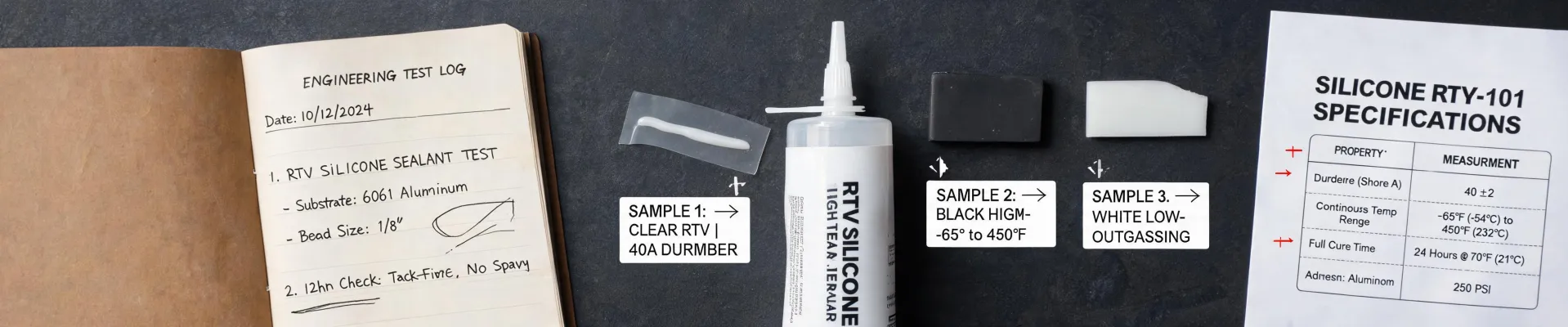
Datasheets list cure conditions. They don't know whether your shop is 14°C and dry or 28°C and humid. In September 2022, I approved a 1-part RTV silicone based on "cures in 24 hours." It didn't cure by day two. Actually, the product datasheet said 25±5°C and 50% RH, and our shop was colder and drier. We waited four extra days and missed a production slot. That one cost $890 in labor and a week of schedule pain. The cure schedule on the Momentive website is tested under controlled conditions, not in your shop. Test it at your temperature before you commit.
3. Decide whether you mean TPU, silicone, or a hybrid
I see a lot of briefs that say "thermoplastic polyurethane silicone" and expect a single answer. There isn't one. TPU and silicone are not interchangeable. TPU is a tough, formable thermoplastic; silicone elastomers are thermosets that hold up in high-heat and flex-fatigue applications. If you are designing a phone case, a TPU material vs silicone phone case comparison has to start with the drop test, hardness, and UV resistance—not just the feel.
I made this exact mistake: I specified a "soft-touch TPU/silicone overmold" without deciding whether the two materials would be bonded chemically or mechanically. The supplier produced it, but the layers separated during assembly. $1,150 of parts went into the scrap bin. The lesson: if you want both, say which is the body and which is the overmold—and how they will bond.
4. Check chemical compatibility before you spec a hose
Whenever I see "hydraulic rubber hose" on a PO, I slow down. Silicone can survive high temperatures, but not every silicone formulation can survive long-term contact with petroleum-based hydraulic fluid. I forgot that in Q1 2024. We built a hose assembly with a silicone outer cover that looked great and met the pressure rating on paper. It failed after 72 hours of oil circulation because the inner liner was wrong. Wait—the inner liner was nitrile, but the fluid chemistry required something else at that temperature range. That order cost $3,200, plus a 3-day delay. If the assembly uses both a hydraulic rubber hose and silicone components, check the fluid compatibility for every elastomer in that system. A silicone part and a rubber hose can both be right for the same system, but in different positions.
5. Price the deadline, not just the unit price
In March 2024, we paid $400 extra for a guaranteed rush delivery. The alternative was missing a $15,000 event, and the failure would have triggered a refund clause. I'm not saying rush fees are always worth it. But if a deadline has a real penalty, the fee is buying certainty—not just speed. The surprise wasn't the $400 fee. It was how much value came from a supplier who put a ship date in writing and hit it. The Momentive website's lead-time information helped me set expectations, but the confirmed delivery date on the purchase order was the thing that actually mattered.
6. Read the datasheet aloud
This sounds dumb, but it works. We now have a rule: every new material order includes a one-paragraph datasheet summary written by the person who will use the material, attached to the PO. In the past 18 months, this rule caught 47 potential errors. Last January, it caught a mismatch between a 2-part silicone kit and the 1-part product code I had approved. The order was already in the warehouse, but nothing had been opened yet. That was probably a $1,100 mistake waiting to happen. The summary must include the full product name and URL from the Momentive website. If the link is dead, the spec is incomplete.
7. Keep a failure log, even if it hurts
My first year in procurement, I made mistakes and hid them. Bad idea. After the third rejection in Q1 2024, I started a shared log called "What Went Wrong." One line per order: material code, wrong spec, what we checked, what we missed. That's how I can say it was 14 significant mistakes and roughly $32,000. The log won't make you look smart. But it stops repeats. I have not had a $500-plus material error since we started the log. That's probably a mix of the checklist and a bit of luck, but I'll take it.
Two Things I Still Tell Every New Buyer
Momentive isn't just a sealant company
The "Momentive = sealants" belief comes from the GE Silicones era. This was true 15 years ago when the brand was mostly known for caulk and sealants. Today, the Momentive website covers silicone rubber, silicone foam, specialty adhesives, and more. If you only search "momentive silicone sealants," you will miss the other categories. Actually, the sealants are a good starting point—but not the whole story.
The cheapest material price isn't the lowest cost
A $12/kg silicone that fails after three weeks costs more than an $18/kg silicone that lasts two years—if your application actually needs that durability. The opposite is also true: don't buy a premium material for a shelf display part. The goal is to match the spec, not to impress the engineer. Put another way, the cheapest part is the one that works the first time.
That's the list. It takes about 20 minutes to run when I order a new material. It saved more than $3,200 in the past year alone, and it probably saved a lot more in headaches. Build your own version. Start with these seven points.